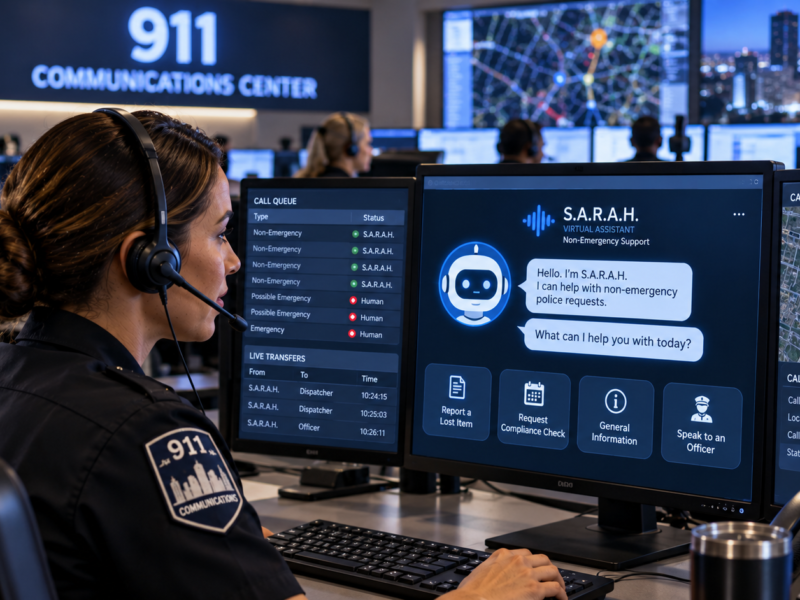
For generations, law enforcement rewarded experience.
The veteran officer often possessed the institutional knowledge, investigative instincts, and practical wisdom that younger officers spent years developing.
Experience still matters.
But the rise of artificial intelligence may introduce a new reality where experience alone may no longer be enough.
The officers who thrive in the coming decade may not necessarily be the most experienced, but the most adaptable.
That distinction could reshape policing in ways many agencies have not yet considered.
The New Divide Is Not About Age
Many discussions about technology assume a divide between younger officers and older officers.
That may be the wrong way to view the issue.
The real divide may be between officers who continuously learn and officers who stop learning.
Artificial intelligence is not simply another software program. It represents a new way of interacting with information, solving problems, and organizing work.
Research consistently shows that adaptability and continuous learning are increasingly important predictors of professional success in rapidly changing environments (World Economic Forum, 2025).
The officers who remain curious about emerging technologies may gain advantages regardless of age or tenure.
Officer Smith and Officer Jones
Imagine two patrol officers.
Officer Smith has fifteen years of experience.
Officer Jones has fifteen years of experience.
Both are respected professionals.
Both know the law.
Both understand policing.
But they respond differently to artificial intelligence.
When AI-assisted report writing becomes available, Officer Smith dismisses it immediately.
“This is just another fad.”
“I’ve been writing reports for fifteen years.”
“I don’t need it.”
Officer Jones takes a different approach.
He studies the technology.
He learns its limitations.
He experiments with it responsibly.
He develops prompts that help organize reports, summarize notes, and identify missing information.
Importantly, he still personally reviews every report.
Over time, Officer Jones begins completing administrative tasks faster while maintaining quality and accuracy.
The difference is not intelligence.
The difference is adaptability.

AI Will Reward Learning Agility
The future police officer may spend less time searching for information and more time evaluating it.
Artificial intelligence can organize data.
It can summarize information.
It can identify patterns.
What it cannot reliably do is determine credibility, intent, deception, or constitutional reasonableness.
Those responsibilities remain human responsibilities.
As AI handles more routine information processing, the value of critical thinking may actually increase (Brynjolfsson & McAfee, 2017).
In other words, AI may not eliminate expertise, but it may expose the difference between expertise and routine.
The Hidden Risk of Professional Obsolescence
Professional obsolescence rarely happens overnight.
It usually occurs gradually.
An officer becomes comfortable.
A supervisor relies on familiar methods.
An agency delays modernization.
Then suddenly the profession changes around them.
The officers who struggle most in future policing may not be the least intelligent, but simply the least willing to adapt.
That pattern has occurred throughout history whenever professions encounter disruptive technology (Rogers, 2003).
Why Human Judgment Becomes More Valuable
Ironically, artificial intelligence may make human judgment more important.
As AI-generated information becomes easier to produce, the ability to verify, question, and evaluate information becomes increasingly valuable.
The future officer may be part investigator, part analyst, and part technology supervisor.
The agencies that recognize this shift early may gain significant operational advantages.
Artificial intelligence is unlikely to replace police officers, but it may change what makes an officer valuable.
The future belongs to officers who combine:
- experience
- critical thinking
- adaptability
- technological awareness
- and continuous learning
The most dangerous assumption in modern policing may be believing that what worked yesterday will automatically work tomorrow.
The officers who thrive in the AI era will not necessarily be the smartest.
They will be the ones who never stop learning.
–American Academy of Advanced Thinking & OpenAI
_________________________________________________________________
References
Brynjolfsson, E., & McAfee, A. (2017). Machine, platform, crowd: Harnessing our digital future. W.W. Norton & Company.
Rogers, E. M. (2003). Diffusion of innovations (5th ed.). Free Press.
World Economic Forum. (2025). The future of jobs report 2025. World Economic Forum.