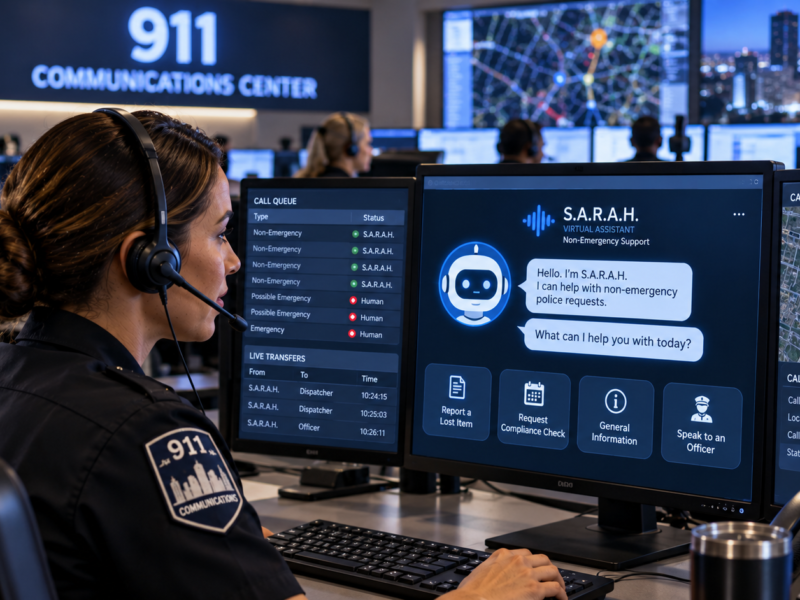
Artificial intelligence is rapidly entering law enforcement.
Officers are using AI to improve report writing. Investigators are exploring AI-assisted case organization. Administrators are evaluating AI tools for policy development, transcription, and workflow automation.
But before agencies ask what an AI platform can do, they should ask a more important question:
Is it CJIS compliant?
Because a powerful AI platform that mishandles sensitive information can create significant legal, operational, and reputational risks.
The reality is simple:
The future of policing will involve artificial intelligence.
The future of policing cannot ignore CJIS.
What Is CJIS?
The FBI developed the Criminal Justice Information Services (CJIS) Security Policy to establish minimum security requirements for protecting Criminal Justice Information (CJI).
This includes information such as:
- Criminal history records
- Investigative information
- Personally identifiable information (PII)
- Fingerprint records
- Arrest information
- Sensitive law enforcement data
Any technology that touches this information must be evaluated carefully.
The AI Question Every Police Leader Should Ask
Many AI companies advertise:
- Military-grade security
- Enterprise protection
- End-to-end encryption
- Government solutions
Those claims sound impressive.
But the real question is:
Can the company demonstrate compliance with CJIS requirements and support law enforcement security expectations?
If the answer is unclear, proceed cautiously.
What To Look For
When evaluating AI platforms, agencies should ask:
Where is the data stored?
Can the vendor identify where information is stored and processed?
Is data encrypted?
Both in transit and at rest.
Is the submitted information used to train future AI models?
This is one of the most important questions.
Are audit logs available?
Can the agency track user activity and access?
Are administrative controls available?
Can supervisors manage permissions and access?
Does the vendor have experience serving government or public safety organizations?
This often indicates a higher level of security maturity.
Warning Signs
Be cautious if a vendor:
- Cannot explain data retention policies
- Uses vague security language
- Cannot provide documentation
- Avoids CJIS-related discussions
- Cannot explain how data is protected
If a company cannot clearly explain security, it may not fully understand it itself.
Human Verification Is Still Required
Even with a CJIS-conscious AI platform, human oversight remains essential.
AI should never replace:
- Officer judgment
- Investigative reasoning
- Constitutional decision-making
- Fact verification
Every AI-generated report, summary, or investigative document should still be reviewed and validated by trained personnel.
The biggest AI risk facing law enforcement may not be artificial intelligence itself.
It may be adopting tools without fully understanding how sensitive information is protected.
Departments that learn AI responsibly while maintaining CJIS awareness may gain operational advantages.
Departments that ignore security may create unnecessary risks.
The goal is not simply to adopt AI.
The goal is to adopt AI responsibly.
–American Academy of Advanced Thinking & OpenAI
__________________________________________
Reference
7 Steps to ensure compliance with the CJIS security policy – Spectral. https://spectralops.io/blog/7-steps-to-ensure-compliance-with-the-cjis-security-policy