Uncertainty and restraint may be signs of better investigative judgment.
Police work often rewards confidence.
Officers are expected to make decisions, explain them, and move situations forward.
But there is a difference between being decisive and pretending to know more than the facts actually support.
Sometimes the most accurate answer is: “I don’t know yet.”
That can feel uncomfortable.
A witness is certain. A timeline seems to fit. A suspect has a history. A piece of evidence points in one direction.
The temptation is to connect the dots quickly.
But what if some of those dots do not belong together?
What if the strongest investigative move is not reaching a conclusion, but recognizing that the conclusion is still forming?
That is where restraint becomes a skill.
Research on situational awareness in policing suggests that sound decisions depend on recognizing relevant information, understanding what it means, and anticipating what may happen next (Huhta et al., 2023). In other words, good judgment begins with seeing the situation as it is, not as we expect it to be.
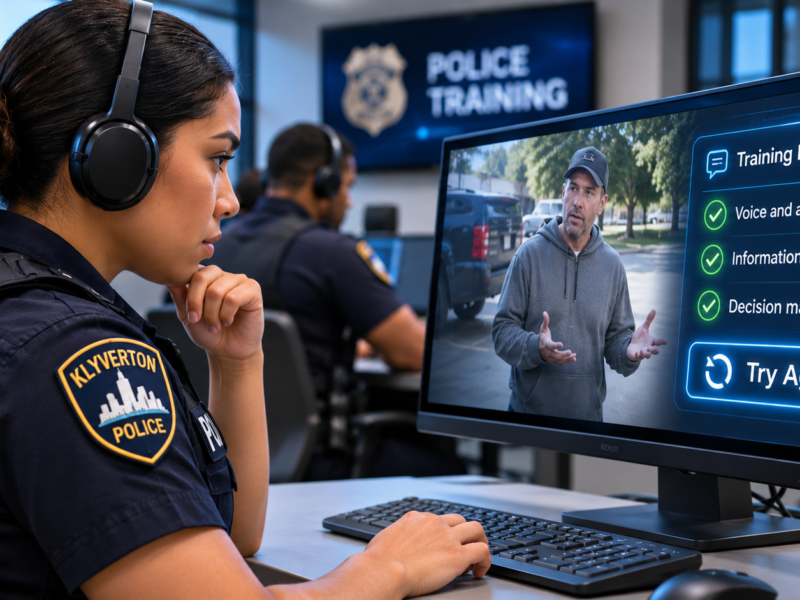
Recent research on police decision-making also supports the value of practicing ambiguity. Espevik et al. (2026) found that structured decision-making training using scenarios and debriefing improved situational awareness among frontline officers working through uncertain situations.
That matters because real investigations rarely arrive neatly packaged.
Imagine this:
A neighbor reports seeing someone leave a house.
A vehicle connected to that person is nearby.
The person has a prior burglary arrest.
Is that enough to conclude the person committed the burglary?
Maybe. Maybe not.
Those facts may support further investigation. They may raise reasonable questions. But they do not automatically answer them.
The better questions are:
- What do we actually know?
- What were we told?
- What are we assuming?
- What has not been verified?
And what fact, if discovered next, could completely change our theory?
That last question is especially important.
Premature certainty can create tunnel vision. Once we believe we know what happened, every new fact can start looking like confirmation.
But endless hesitation creates its own problem. Officers also have to recognize when enough information exists to act.
So the lesson is not: Always wait.
It is: Know when you have enough, and know when you do not.
That distinction should be practiced.
Training scenarios can intentionally withhold information, introduce contradictions, shift timelines, or reveal evidence that doesn’t fit the officer’s first theory.
Then the officer has to make a choice:
Act?
Investigate further?
Change direction?
Or say, for now: “I don’t know yet.”
That may be one of the most important sentences in investigative work.
Strong judgment is not about always having an answer.
Sometimes it is about having the discipline not to invent one.
–Klyvorek & OpenAI
KLYVOREK is a scenario-based training platform that helps Criminal Justice Programs, Police Academies, FTOs, and individual learners strengthen investigative judgment, decision-making, and police documentation through realistic fictional cases and AI-assisted practice.
_______________________________________
References
Espevik, R., Rose-Saus, E., Johnsen, B. H., Sanden, S., & Olsen, O. K. (2026). Decision-making training for frontline police officers: Effects on situational awareness and team behavior. Scandinavian Journal of Psychology, 67(2), 596–604. https://doi.org/10.1111/sjop.70050.
Huhta, J.-M., Di Nota, P. M., Hietanen, T., & Ropo, E. (2023). Deriving expert knowledge of situational awareness in policing: A mixed-methods study. Journal of Police and Criminal Psychology, 38, 539–554.