Police training has traditionally faced a practical problem: realistic scenarios are valuable, but they can be expensive, difficult to repeat, and dependent on instructors, role players, facilities, and time.
Two recent developments suggest that the next generation of police training may address that problem in different, but surprisingly complementary, ways.
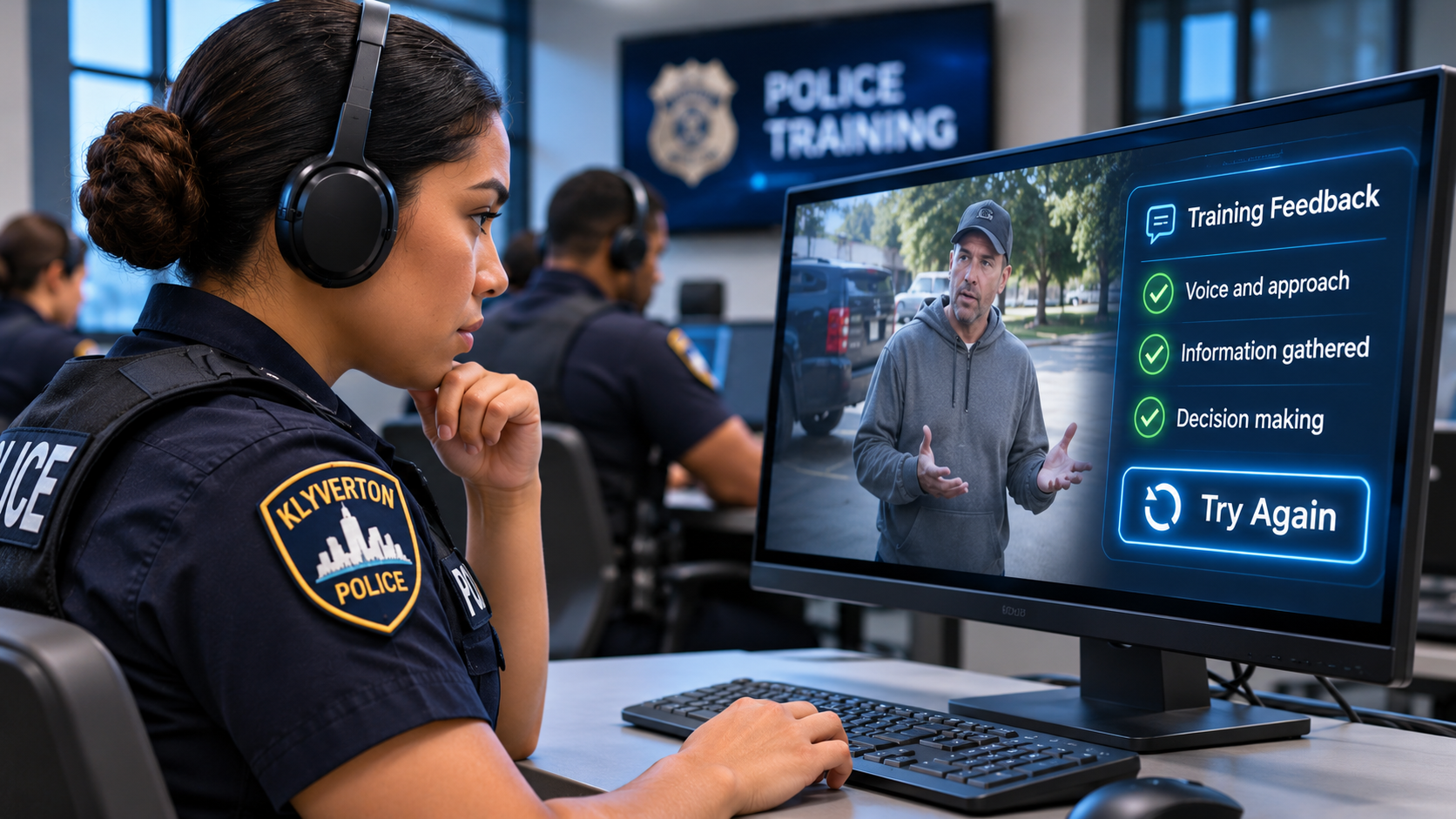
At the University of Illinois Police Training Institute, researchers have developed Voysses, an AI-powered communication platform that allows recruits to practice difficult conversations with responsive virtual personas. Instead of choosing from predetermined answers, recruits can speak or type naturally, receive an unscripted response, and adjust as the conversation develops. The system is used to build skills such as trauma-informed communication, active listening, empathy, and decision-making. The development team won a $25,000 TechRise award in October 2026 to continue advancing the platform (University of Illinois Graduate College, 2026).
Several days later, a very different training story emerged from Glynn County, Georgia.
Personnel participated in a five-day Reality-Based Training course led by Ken Murray. Officers worked through simulated domestic conflicts, vehicle incidents, and suspicious-person encounters. Instructors watched their performance, provided feedback, and, critically, allowed participants to repeat exercises and improve their responses (News Now Georgia, 2026).
One approach uses artificial intelligence.
The other uses live role players.
But the important idea is the same: The scenario should not end when the learner makes the first decision.
Police work involves skills that are difficult to develop through lecture alone. Communication changes when the other person becomes angry. Decision-making changes when information becomes incomplete. Judgment changes when the situation no longer resembles the example in the textbook.
Research supports training that combines scenarios with feedback and debriefing. Espevik et al. (2026) found that police officers who received decision-making instruction involving frameworks, scenarios, and group debriefings demonstrated stronger situational awareness, with benefits to team behavior among regular officers in ambiguous scenarios.
Earlier academy research likewise found value in spaced practice, scenario-based feedback, and repeated performance measurement. O’Neill et al. (2019) reported that structured practice and feedback could improve cadet performance and help instructors identify skills requiring additional development.
This raises a useful question for academy directors and criminal justice educators.
Why should a scenario be treated like a final examination?
Imagine instead that a recruit handles a difficult witness poorly.
The instructor identifies the problem.
The recruit tries again.
Then the situation changes.
The witness becomes more emotional.
A fact changes.
A contradiction appears.
The recruit must adapt.
Now add another layer: after the conversation, require the learner to document what happened.
What did the person actually say?
What did the recruit observe?
What was assumed?
Which facts support the next action?
That creates a continuous training loop:
Experience. Decide. Receive feedback. Repeat. Document. Reflect.
AI can make some forms of practice more available and responsive. Reality-based training can provide the physical and interpersonal complexity technology may not reproduce. Neither needs to replace the other.
The opportunity is to combine their strongest feature: Give learners more chances to make decisions, and more chances to learn from them.
Police training may become more sophisticated not because the technology becomes more impressive, but because practice becomes more frequent, responsive, measurable, and repeatable.
Perhaps the better question is no longer: Did the recruit complete the scenario?
It is: What changed the second time around?
–Klyvorek & OpenAI
KLYVOREK is a scenario-based training platform that helps Criminal Justice Programs, Police Academies, FTOs, and individual learners strengthen investigative judgment, decision-making, and police documentation through realistic fictional cases and AI-assisted practice.
_______________________________________
References
Blumberg, D., Schlosser, M., Papazoglou, K., & Creighton, S. (2019). New Directions in Police Academy Training: A Call to Action. International Journal of Environmental Research and Public Health, 16(24), n/a.
Espevik, R., Rose-Saus, E., Johnsen, B. H., Sanden, S., & Olsen, O. K. (2026). Decision-making training for frontline police officers: Effects on situational awareness and team behavior. Scandinavian Journal of Psychology, 67(2), 596–604. https://doi.org/10.1111/sjop.70050.
News Now Georgia. (2026, November 15). Glynn County personnel practice responses in five-day training course.
O’Neill, J., O’Neill, D. A., Weed, K., Hartman, M. E., Spence, W., & Lewinski, W. J. (2019). Police academy training, performance, and learning. Behavior Analysis in Practice, 12, 353–372.
University of Illinois Graduate College. (2026, November 11). ICR doctoral student on interdisciplinary team develops AI communication-training platform for law enforcement.