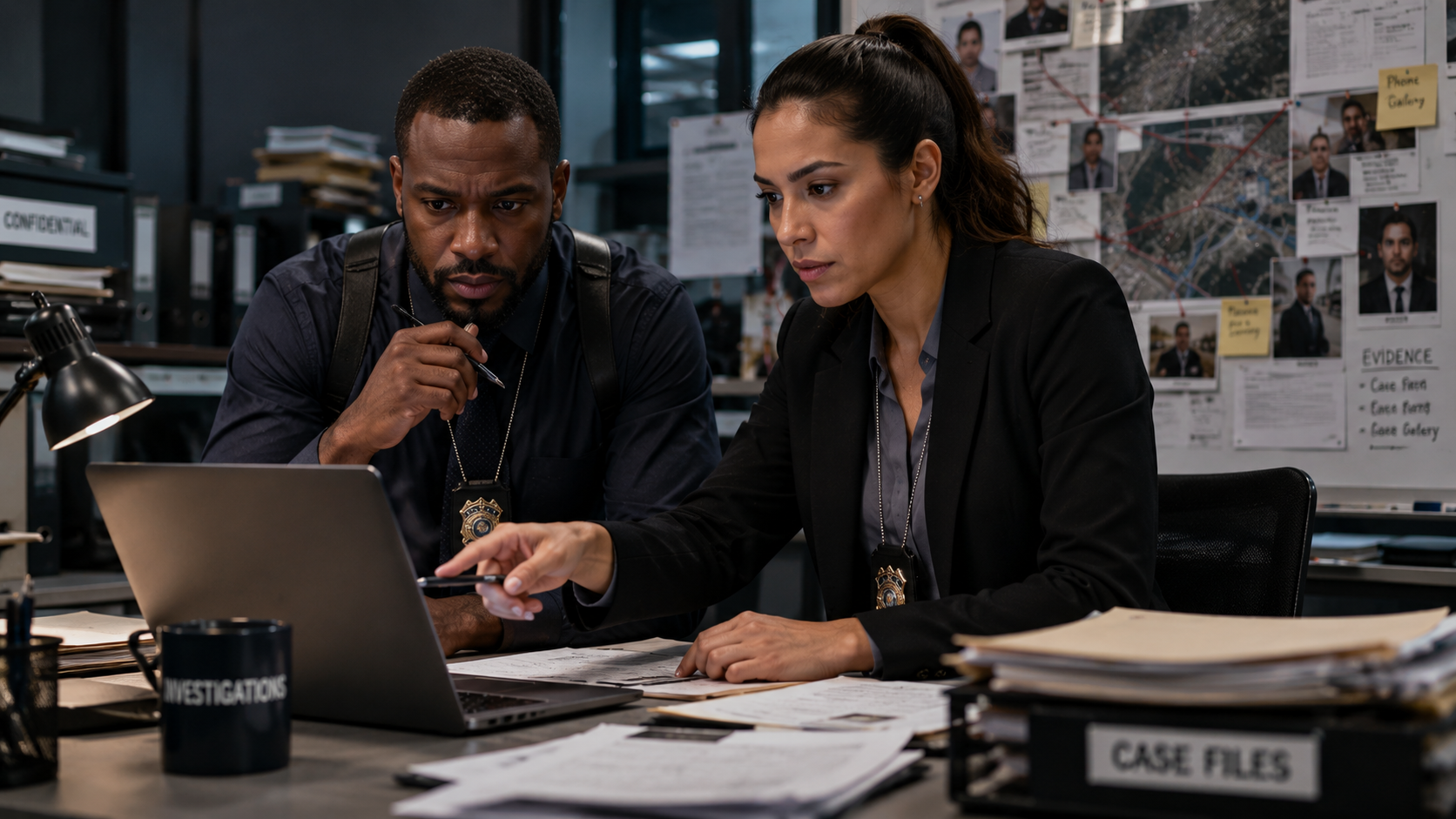
Modern criminal investigations generate enormous amounts of information. Detectives and investigators routinely process surveillance footage, phone records, witness statements, digital evidence, social media activity, forensic reports, and investigative notes, all while trying to identify patterns and establish probable cause.
Artificial intelligence is beginning to change how investigators manage that complexity.
AI systems are increasingly being used to assist investigators with:
- timeline creation
- evidence categorization
- digital evidence review
- facial recognition analysis
- transcription
- pattern identification
- open-source intelligence (OSINT)
These technologies can significantly reduce the time required to organize large volumes of information.
According to MITRE (2025), AI has the potential to improve law enforcement efficiency by helping agencies process and analyze information more effectively while supporting, not replacing, human decision-making.
This distinction is critical.
The greatest strength of AI in investigations is not intelligence. It is speed and structure.
For example, investigators handling large fraud, homicide, or organized retail crime cases often encounter thousands of pages of documents, financial records, surveillance logs, and communications. AI-assisted systems can rapidly categorize these materials, allowing investigators to focus on analysis rather than administrative sorting.
Similarly, AI-driven transcription tools can convert lengthy interviews into searchable text within minutes, dramatically reducing manual review time.
However, investigators must understand AI’s limitations.
AI systems can:
- misinterpret context
- incorrectly summarize statements
- reinforce bias
- create false associations
- overlook nuance
Investigative reasoning still requires human judgment, constitutional analysis, corroboration, and experience.
Overreliance on AI can lead to dangerous assumptions if investigators trust automated conclusions without independent verification.
This is especially important in areas involving:
- suspect identification
- predictive analysis
- probable cause development
- digital evidence interpretation
Future-ready investigators will likely become hybrid professionals—part investigator, part information strategist.
The investigator of the future may spend less time manually organizing information and more time:
- evaluating evidence credibility
- identifying contradictions
- analyzing behavioral patterns
- validating investigative conclusions
Artificial intelligence is not replacing investigations. It is reshaping investigative workflow.
The agencies that adapt responsibly may gain significant operational advantages in speed, organization, and analytical efficiency.
–American Academy of Advanced Thinking & Open AI
___________________________________________
References
MITRE. (2025). AI for law enforcement: Intelligence after next. https://www.mitre.org
National Institute of Justice. (2024). Artificial intelligence and criminal investigations. U.S. Department of Justice. https://nij.ojp.gov