A Klyvorek Field Observation Case Study
The setting
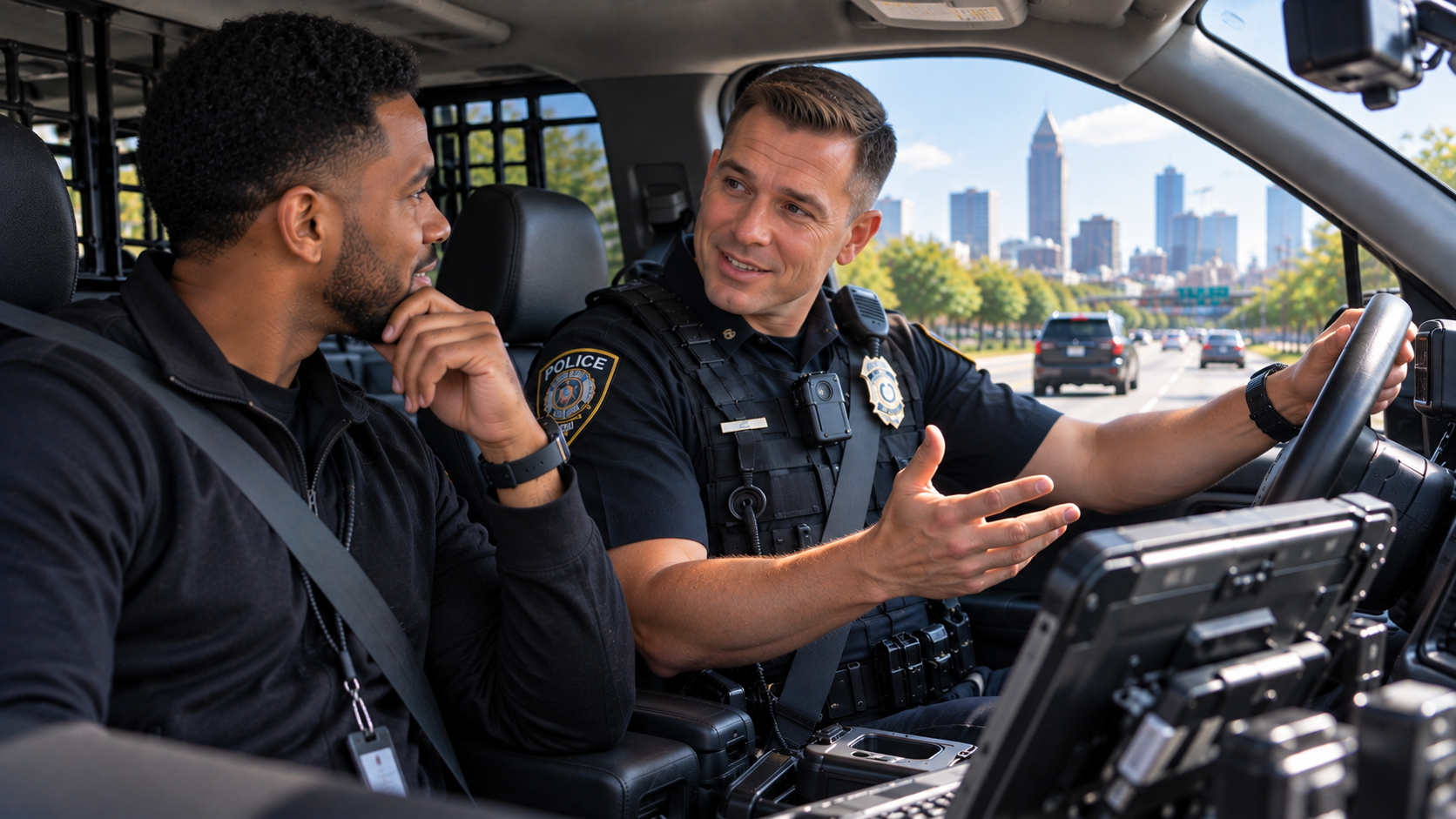
During a recent ride-along with a Metro Atlanta police officer, Edward Brown observed something both familiar and revealing.
After more than three decades in law enforcement, investigations, and public safety, Brown recognized that the fundamentals of patrol had not dramatically changed. Officers still responded to calls, gathered facts, spoke with people, made decisions, and documented what happened.
Technology had changed, but the work around police reports remained burdensome.
The officer used a records management system to complete incident reports. The department had recently changed systems but later returned to a previous platform. From the officer’s perspective, the restored system appeared more cumbersome than the earlier workflow.
That observation exposed a critical distinction:
A records management system can store a report without making the report easier to create.
The officer’s insight
During the conversation, the officer identified two situations in which AI-assisted report writing could be valuable.
First, it could help officers who are inclined to leave out details.
Second, its greatest value might appear when an officer has several reports waiting to be completed.
Those observations point to a problem deeper than grammar.
An officer may clearly understand an incident and still produce an incomplete report. The cause may not be carelessness or lack of ability. It may be divided attention, fatigue, interruptions, memory pressure, or the desire to finish one report before another call arrives.
When reports accumulate, officers must mentally preserve several unrelated events:
- Who was involved?
- What did each person say?
- What did the officer personally observe?
- What evidence was collected?
- What action was taken?
- What still requires follow-up?
The more incidents competing for attention, the more likely important details are to disappear.
The Report Stack Effect
This case suggests the existence of a Report Stack Effect: as unfinished reports accumulate, the officer’s cognitive burden rises, creating pressure to shorten, simplify, or mentally compress each incident.
The risk is not always an obviously inaccurate report. It may be a report that is technically correct but operationally incomplete.
A missing observation, unclear timeline, unidentified source, or unexplained action may later create problems for:
- Supervisors reviewing the report
- Investigators conducting follow-up
- Prosecutors evaluating the case
- Defense attorneys testing inconsistencies
- Officers attempting to recall the incident months later
- Chiefs responding to complaints or litigation
A detail that appears minor at the end of a busy shift may become central in court.
The real opportunity for AI
The ride-along suggested that AI’s strongest role is not replacing officer judgment. It is helping preserve the officer’s judgment before workload pressure erodes the documentation.
A well-designed system could prompt the officer to identify missing facts, separate observations from statements, organize the sequence of events, and produce a structured first draft.
The officer would remain responsible for reviewing, correcting, and approving every word.
This creates a practical space between two existing options:
- Writing the entire narrative manually inside a cumbersome records system.
- Purchasing an expensive platform deeply integrated with body-camera technology.
Many small and mid-sized departments may not be ready for the second option. They may not need to replace their current records system at all.
They may need a secure, affordable drafting layer that helps officers organize their own facts before placing the final report into the department’s approved system.
The Klyvorek opportunity
This is the space Klyvorek is being built to occupy.
Klyvorek does not need to tell officers how an incident occurred. The officer supplies the facts. The platform helps turn those facts into a clear, structured draft while identifying areas that may require clarification.
Its future opportunity may include a Report Stack Mode that allows officers to:
- Keep multiple incidents clearly separated
- Capture essential facts before details fade
- Identify incomplete timelines
- Flag unsupported conclusions
- Distinguish direct observations from secondhand statements
- Track which drafts still need information
- Maintain control over the final report
What this case does, and does not, prove
One ride-along and one officer’s perspective cannot establish how all officers or departments experience report writing. It does not prove that AI will reduce reporting time or eliminate missing details.
It does, however, reveal a strong, testable hypothesis: AI-assisted documentation may deliver its greatest value not during an ordinary report, but when report volume, fatigue, and system friction put report completeness at risk.
That hypothesis should now be tested through officer interviews, supervisor feedback, controlled pilots, report-return rates, completion times, and measures of missing-information frequency.
The real opportunity for AI in policing may not be writing reports faster.
It may be helping capable officers preserve the complete story of their work when their attention is being pulled in several directions.
Police departments already have systems that store reports. What many officers still lack is a system that helps them think through the report before the details are lost.
That is not automation replacing police work.
It is technology helping police work survive the report-writing process.
–American Academy of Advanced Thinking & OpenAI