Police departments generate enormous amounts of information. Incident reports, 911 transcripts, and other records may contain connections or indicators that investigators, supervisors, and specialized units struggle to identify manually. An emerging experiment in Georgia offers an early glimpse at how artificial intelligence might help departments search that information differently.
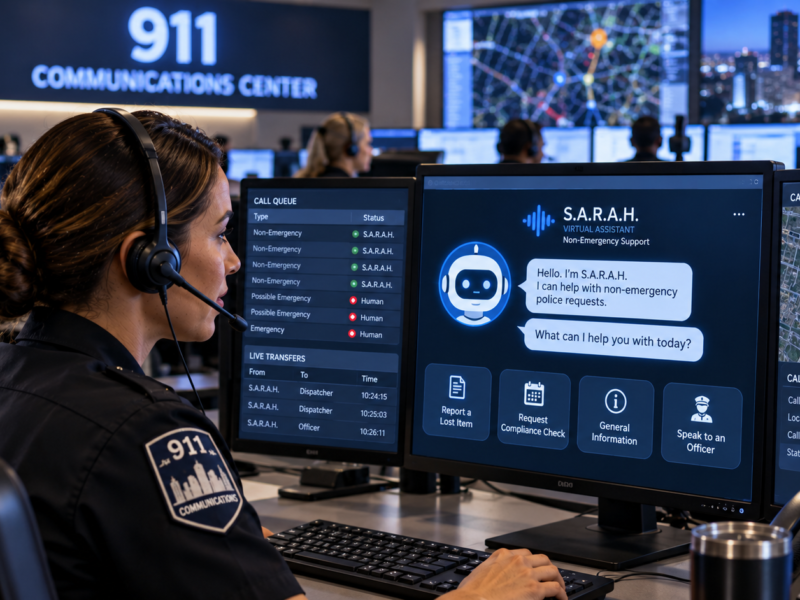
In August 2026, Kennesaw State University (KSU) announced a pilot involving the Moultrie Police Department and CaseFinder, an AI system commercialized by Technovative AI. The system uses natural language processing and machine learning to examine police incident reports and 911 transcripts for indicators of possible behavioral health crises and prioritize records for human follow-up (Kennesaw State University [KSU], 2026).
The concept did not begin as a commercial product. KSU researchers previously developed machine learning methods using police narratives from a partner agency. In a peer-reviewed Smart Health study, Brown et al. (2024) tested their model on 300 manually annotated police reports. The researchers reported 87.58% accuracy and an F1 score of 85.67% initially; a human-in-the-loop active-learning approach increased reported performance to 92% accuracy and a 91.1% F1 score. On unseen samples, the researchers reported 93.75% accuracy and a 93.61% F1 score.
Those numbers are encouraging, but department leaders should interpret them cautiously. They describe experimental performance on a limited research dataset, not proof that the technology will achieve comparable results across different agencies, populations, reporting styles, or operational environments. The Moultrie deployment is a pilot, making questions about false positives, false negatives, workflow, privacy, and downstream use especially important.
The bigger idea may matter more than this particular application.
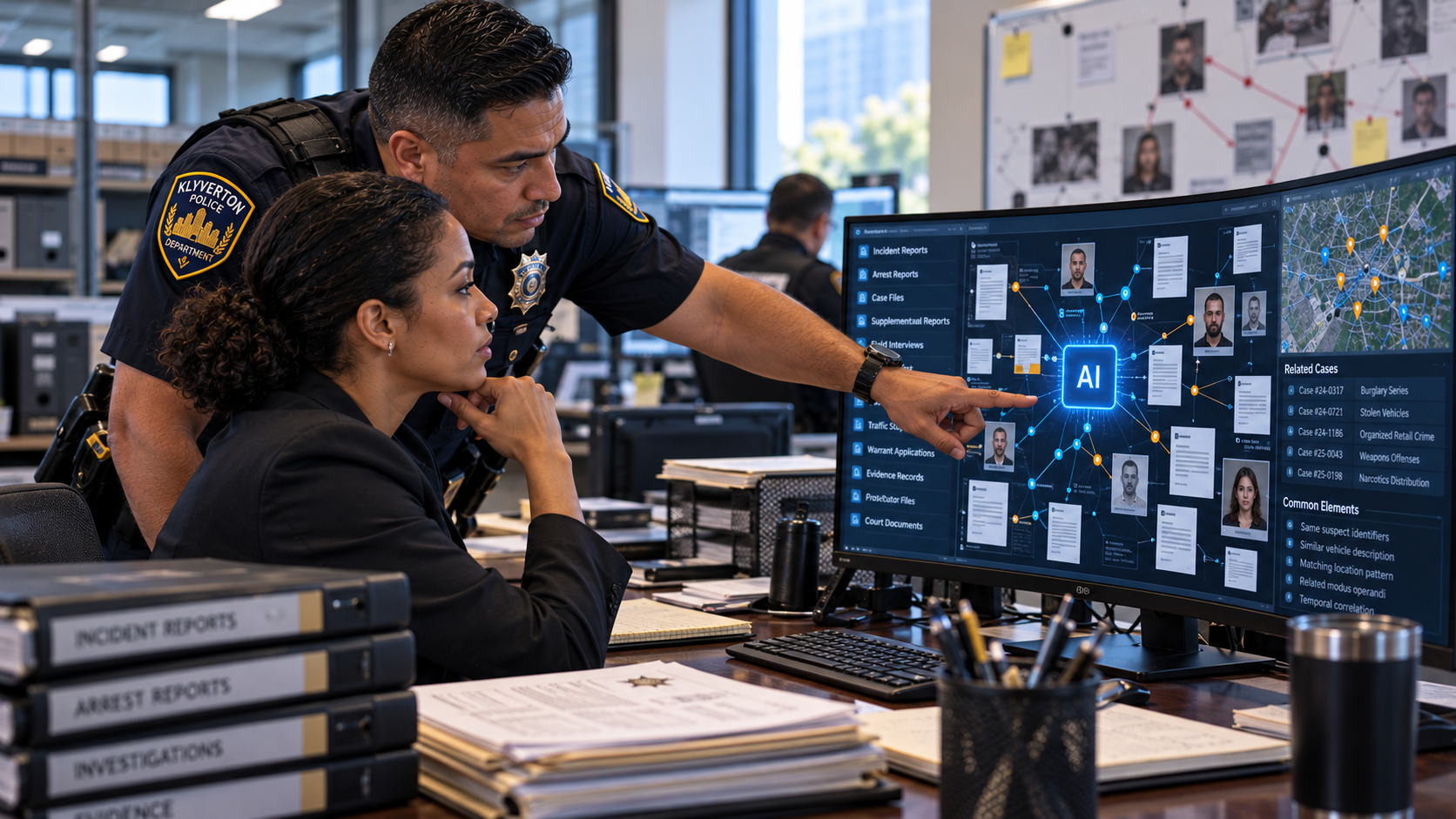
Today, officers primarily create records so another person can retrieve and read them later. AI could eventually make those records computationally searchable for patterns that were never explicitly coded when the report was written. Behavioral health indicators are one experiment. Similar techniques might someday help investigators identify repeat victimization, related incidents, overlooked leads, or emerging patterns across large collections of reports. Those possibilities remain forecasts, not demonstrated CaseFinder capabilities.
For police chiefs, this creates an important governance question. If AI discovers something that no officer originally documented as a conclusion, what exactly has the department created: a lead, an intelligence product, or an algorithmic inference about a person?
The department should resolve that distinction before experimental systems become routine investigative tools.
–Klyvorek & OpenAI
KLYVOREK, a division of the American Academy of Advanced Thinking, LLC, is an AI-assisted law enforcement documentation platform that helps officers create clear, structured incident reports and draft search and arrest warrant applications, while keeping the officer in control of the final document.
_____________________________________
References
Brown, M., Azmee, A. A., Khan, M. A. A. H., Thomas, D., Pei, Y., & Nandan, M. (2024). Adaptive attention-aware fusion for human-in-the-loop behavioral health detection. Smart Health, 32, 100475. https://doi.org/10.1016/j.smhl.2024.100475.
Kennesaw State University. (2026, August 20). KSU, Technovative AI sign pilot agreement with Moultrie Police Department for AI-powered behavioral health detection tool. https://www.kennesaw.edu/news/stories/2026/ksu-technovative-ai-sign-pilot-agreement-moultrie-police.php.