A new officer’s first police report should not be the first time that officer discovers whether they can document a complicated incident.
Yet police report writing presents an unusual training problem. Officers must learn how to observe, interview, investigate, make decisions, and then convert those activities into an accurate written record for people who were not there.
That last step deserves more attention.
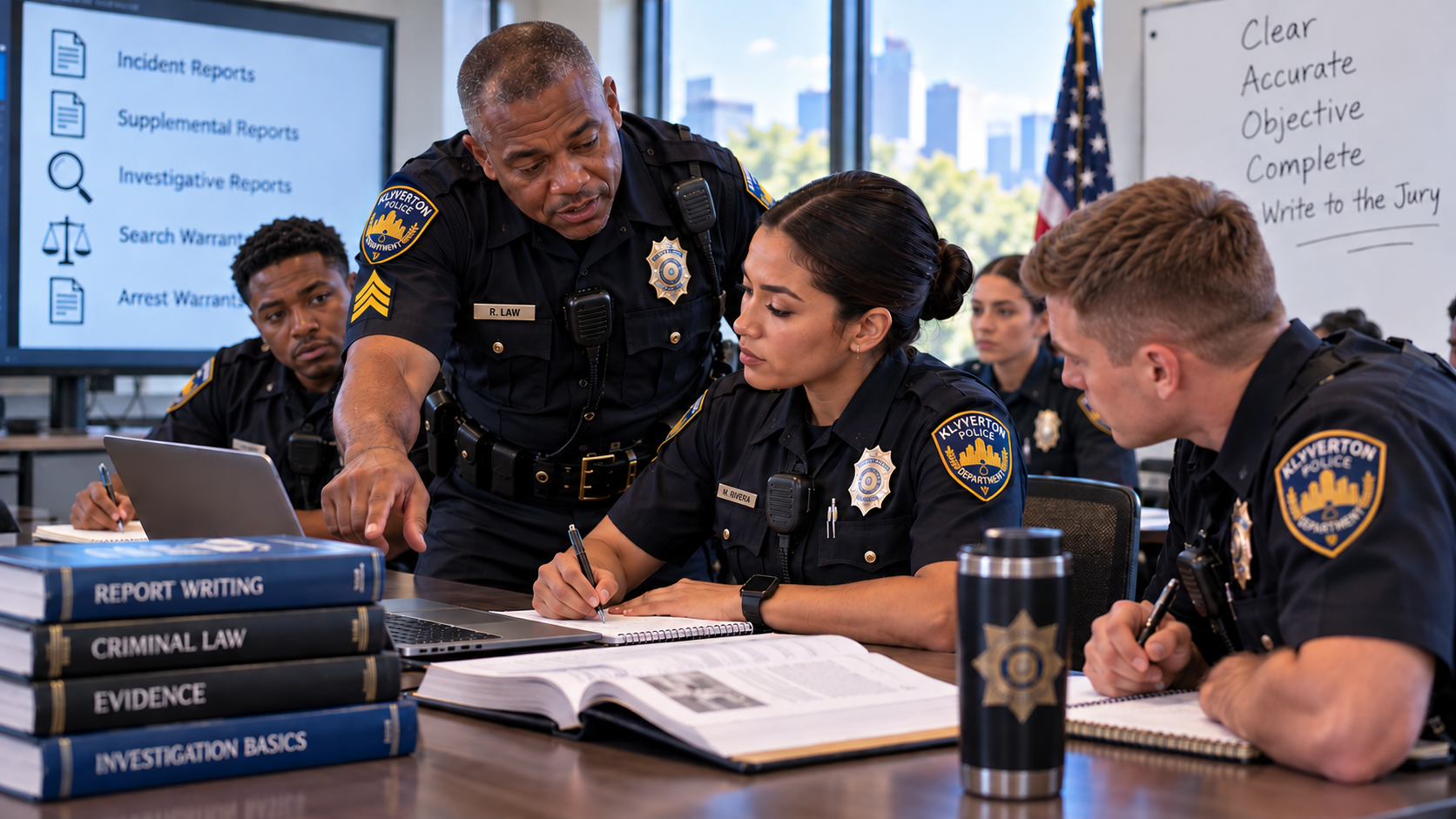
Federal law enforcement training materials have long treated report writing as a core competency. Police Training Officer guidance emphasizes clear, concise, accurate, objective documentation across patrol, emergency response, and criminal investigations (Office of Community Oriented Policing Services [COPS Office], 2006). Older training literature makes an equally relevant point: police reports should communicate facts simply and unambiguously rather than imitate complicated “police writing” (Rutledge, 1977). But knowing those principles and applying them under pressure are different things.
New officers need repetition before consequences.
Before documenting an actual domestic dispute, burglary, assault, theft, or complicated arrest, recruits should have worked through realistic fact patterns requiring them to determine:
-What information matters?
-What is fact versus inference?
-What belongs in the narrative?
-What is missing?
-Can another person reconstruct the incident from the report?
-Would a supervisor understand it?
This is where artificial intelligence presents an interesting, but potentially misunderstood, training opportunity.
AI should not give recruits an escape from learning to write reports.
It could give them a laboratory for learning it.
Imagine an FTO assigning a fictional burglary scenario. The recruit documents the incident, receives structured assistance organizing the facts, reviews the resulting narrative, identifies omissions, makes corrections, and discusses those decisions with the FTO.
Then the recruit does it again, and again.
Modern AI-assisted police reporting already reinforces the importance of officer review and supervisory oversight. The COPS Office describes implementations in which officers review AI-created drafts and supervisors or auditors compare reports against underlying information.
That suggests a larger opportunity.
Before asking whether AI can make experienced officers faster, departments should ask whether it can help new officers become better documenters.
The objective should never be to teach recruits to press a button and accept whatever the AI produces.
It should teach them to recognize when documentation is complete, accurate, clear, objective, or wrong.
The safest place for a new officer to make a reporting mistake is not in a real criminal case.
It is inside a realistic training scenario where the mistake becomes the lesson.
Klyvorek & OpenAI
KLYVOREK, a division of the American Academy of Advanced Thinking, LLC, is an AI-assisted law enforcement documentation platform for report writing, structured search, and arrest warrant application drafts, while keeping law enforcement personnel in control of the final document.
______________________________
References
Office of Community Oriented Policing Services. (2006). Police Training Officer (PTO) program: A contemporary approach to post-academy recruit training. U.S. Department of Justice. Office of Justice Programs.
Office of Community Oriented Policing Services. (2025). Using AI to write police reports. U.S. Department of Justice. COPS Office.
Rutledge, D. (1977). It’s easy to write better police reports. California Commission on Peace Officer Standards and Training. Office of Justice Programs.