Artificial intelligence is moving closer to the front door of policing.
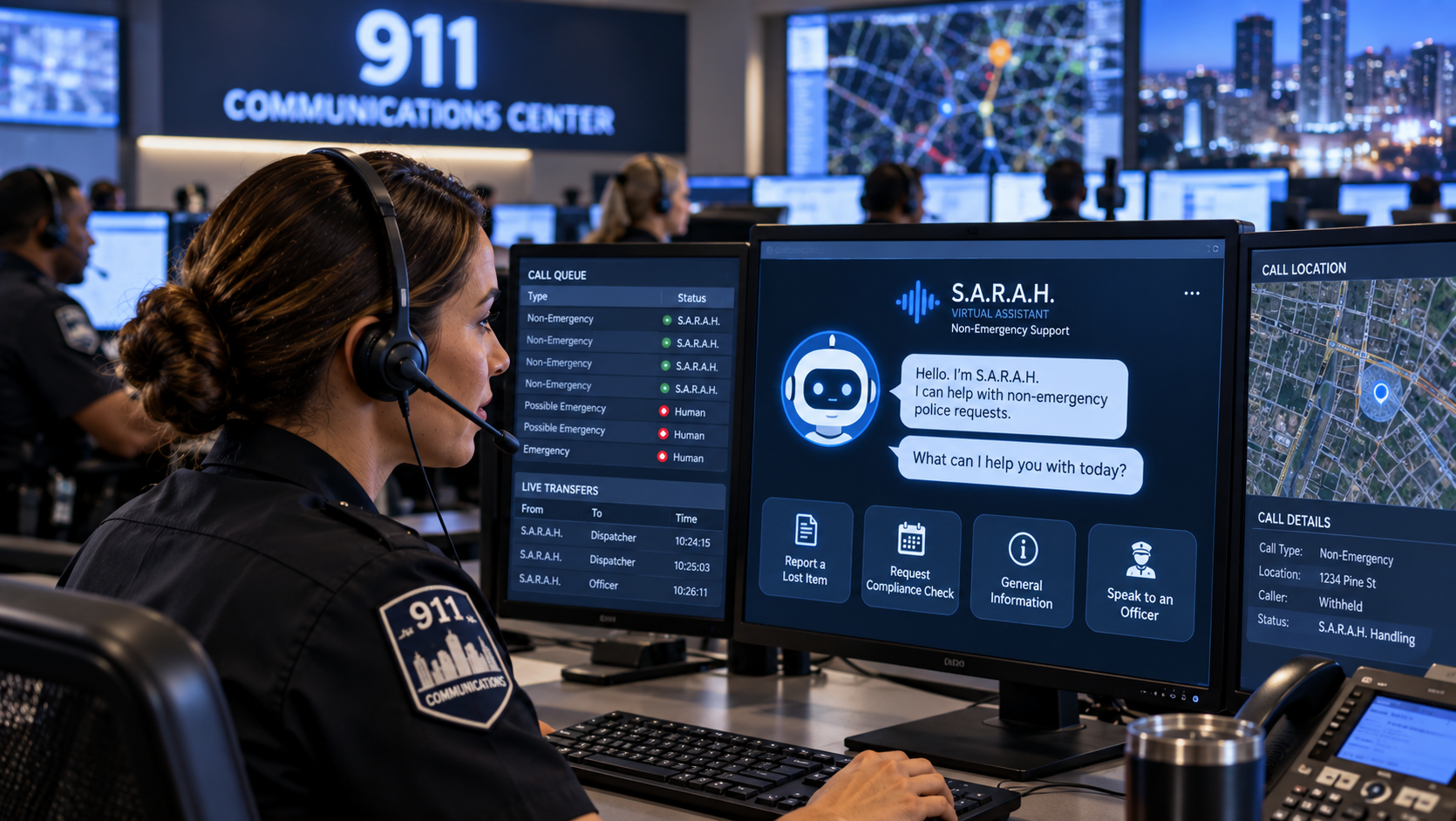
On September 23, 2026, the Colorado Springs Police Department began using an AI agent called S.A.R.A.H. to answer non-emergency calls before a human call taker becomes involved.
Trained personnel still answer all 911 calls. But non-emergency calls account for more than half of the traffic the communications center receives, and AI now screens those calls first (City of Colorado Springs, 2026).
The early numbers are noteworthy.
During four test periods totaling 54 hours, S.A.R.A.H. reportedly completed about 49% to 50% of non-emergency calls without transferring them to a human. Before implementation, callers on the non-emergency line typically waited more than 30 seconds. Police now report almost no wait for those calls (Westin, 2026).
Fewer routine calls may allow human telecommunicators to focus on emergencies, while AI can provide information, translate conversations, transcribe calls, summarize details, and route appropriate requests.
But it also raises a new governance question: When should AI stop and hand the call to a human?
That may be more important than the technology’s average handling time.
Departments adopting this type of system should consider establishing a Human Escalation Standard.
Certain circumstances could automatically trigger human review: uncertainty about immediate danger, weapons, domestic violence, threats, unusual caller behavior, children, medical distress, rapidly changing conditions, or language the AI cannot confidently interpret.
Chiefs should also consider measuring something beyond calls successfully automated.
They should measure false reassurance.
How many calls did the system classify as routine that a human later determined required urgent attention?
Professional organizations are already treating AI in emergency communications as a significant operational issue. APCO International is developing best practices for AI integration into emergency communications centers, including training, cybersecurity, legal, ethical, and implementation considerations (APCO International, 2026).
The goal should not simply be replacing work.
It should improve response while preserving human judgment where the consequences are highest.
Today, AI may answer the non-emergency line.
Tomorrow, it may influence which calls receive attention first.
For police chiefs, the question is no longer merely: Can AI answer the phone?
It is: When must a human take over?
Klyvorek & OpenAI
KLYVOREK helps law enforcement professionals strengthen report-writing skills through realistic fictional scenarios, self-paced practice, and AI assistance. The officer provides the facts. KLYVOREK builds the draft. The officer reviews, refines, and improves it.
____________________________________
References
APCO International. (2026). Artificial intelligence in emergency communications.
City of Colorado Springs. (2026, September 22). CSPD launches Prepared by Axon to enhance emergency and non-emergency call response.
Westin, C. (2026, September 23). AI chatbot begins answering Colorado Springs non-emergency calls. Colorado Politics.