Imagine beginning investigator training without an instructor telling you what happened.
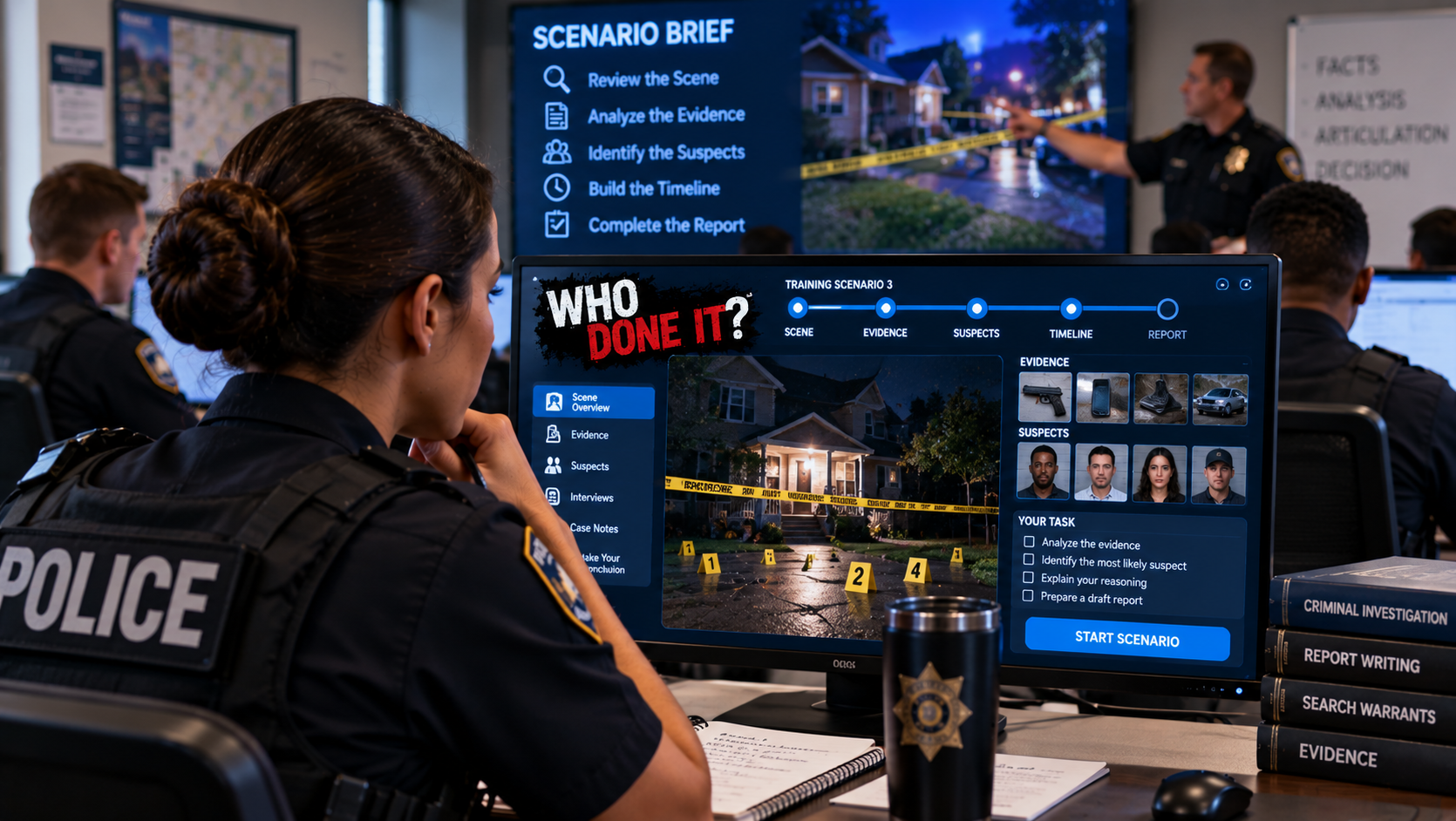
You enter a simulated crime scene. Evidence is scattered throughout the environment. Witnesses have information, but not necessarily everything. You decide whom to interview, what evidence matters, and what investigative path to follow.
Get it wrong, and nobody gets hurt. You just start over.
This “who done it?” approach represents an emerging form of gamified police training: using interactive scenarios, objectives, feedback, consequences, and repetition to teach judgment rather than simply test knowledge.
The concept is no longer theoretical. A 2026 study at the Dubai Police Academy evaluated gamified crime scene investigation training involving 60 cadets. Researchers reported statistically significant improvements in procedural accuracy, evidence management, and decision-making, with measured performance gains ranging from 25% to 35% (Alsuwaidi, 2026). A separate 2026 study examined gamified simulation for traffic incident response at the same academy (Alsuwaidi et al., 2026).
This does not establish that gamified training is superior across policing. These remain limited studies requiring replication in different agencies and training environments.
So, why is this emerging now?
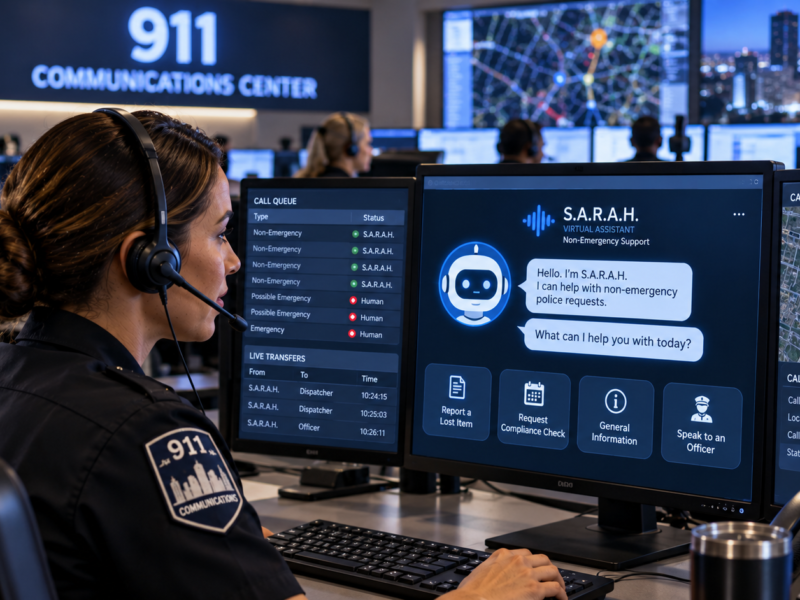
The answer may be the convergence of gaming technology, virtual reality, and artificial intelligence.
Game-based police training itself has existed for years. NIJ-sponsored research previously examined low-cost virtual environments for practicing decision-making under stress (Lewis & Hartholt, 2020). AI could change this by creating scenarios that don’t have to unfold the same way every time.
Researchers now envision AI-generated scenarios, more responsive virtual characters, and automated feedback within police simulations (Dymond, 2026). Instead of memorizing the correct response to a prerecorded scenario, an officer could eventually encounter changing witnesses, evidence, behaviors, and consequences.
That could make a “who done it?” exercise particularly interesting for investigators.
Imagine giving detectives the same virtual homicide but subtly changing one fact. Did they recognize the inconsistency? Did confirmation bias influence the investigation? Did they pursue exculpatory evidence? Can they articulate why they identified one person as the suspect?
The opportunity is not to turn policing into a video game.
It is to borrow something games understand remarkably well: people learn by making decisions, seeing consequences, receiving feedback, and trying again.
For department heads, the question may soon become:
What critical decisions do we currently teach in a classroom that officers should be allowed to practice, and fail at, 100 times before making them once in the real world?
–Klyvorek & OpenAI
KLYVOREK helps law enforcement professionals strengthen report-writing skills through realistic fictional scenarios, self-paced practice, and AI assistance. The officer provides the facts. KLYVOREK builds the draft. The officer reviews, refines, and improves it.
_______________________________
References
Alsuwaidi, A. (2026). Gamified situated learning for crime scene investigation: An empirical study at Dubai Police Academy. Policing: A Journal of Policy and Practice, 20(Supplement 1), i116–i124. https://doi.org/10.1093/police/paag003.
Alsuwaidi, A., Alawlaqi, N., Yateem, E., Darwish, M., & Alsuwaidi, A. (2026). Gamifying traffic incident response: A pilot simulation study at the Dubai Police Academy. Simulation & Gaming. https://doi.org/10.1177/10468781261439724.
Dymond, A. (2026). Training the future of policing: Can immersive simulation, games, and AI provide valuable assets? An opinion piece. Policing: A Journal of Policy and Practice, 20, paag023. Requires replication acrossttps://doi.org/10.1093/police/paag023.
Lewis, M. W., & Hartholt, A. (2020). Effective game-based training for police officer decision-making: Linking missions, skills, and virtual content. National Institute of Justice.
Maathuis, C. (2024). Design Framework for VR Games in the Police Domain. European Conference on Games-Based Learning, (), 571-579.