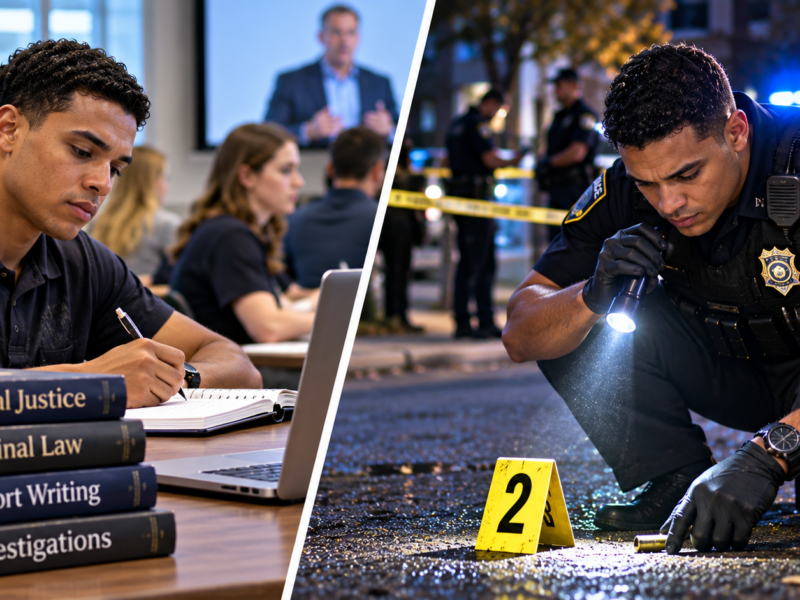
Police officers face situations that demand quick decisions, objective fact-finding, and accurate documentation.
But can traditional classroom instruction adequately prepare officers for these responsibilities?
Recent developments suggest that law enforcement training increasingly embraces realistic, scenario-based experiences that let officers practice before facing similar situations in the field.
From Classroom Instruction to Realistic Experiences
In October 2026, the New York City Police Department (NYPD) launched a retraining initiative that incorporates virtual reality simulations for about 26,000 officers.
The program exposes officers to situations involving armed suspects, active shooters, and individuals experiencing mental health crises. Instructors can evaluate decisions, reactions, and timing within controlled environments (ABC7 New York, 2026).
Meanwhile, researchers at the University of Texas at Arlington have developed an artificial intelligence (AI)-powered virtual reality training system featuring five adaptive scenarios. Unlike traditional scripted simulations, virtual individuals respond dynamically to officers’ verbal communication (Spectrum News, 2026).
These initiatives suggest a significant shift: Police training is becoming less about memorizing information and more about applying knowledge under realistic conditions.
Critical Thinking Must Extend Beyond the Scene
Realistic training should not end when a simulated encounter concludes.
Consider an officer responding to a suspicious death. The officer must identify relevant evidence, distinguish observations from assumptions, evaluate conflicting statements, and establish a defensible timeline.
But another challenge follows.
- Can the officer explain those findings clearly in an incident report?
- Can the officer articulate probable cause for a search warrant?
- Can the officer distinguish facts from investigative conclusions?
These responsibilities require critical thinking, problem-solving, legal reasoning, and effective writing.
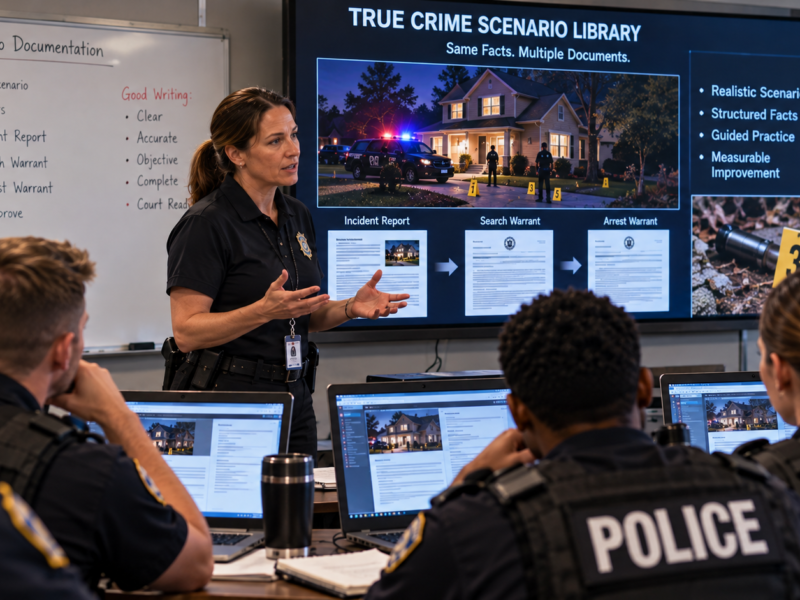
Scenario-based training offers opportunities to practice these connected skills.
An Opportunity for Smaller Police Departments
Virtual reality equipment may be expensive, but realistic training does not necessarily require sophisticated technology.
Interactive investigations, fictional criminal cases, structured writing exercises, and AI-assisted feedback can provide accessible opportunities for continued practice.
AI can support training, but instructors must verify the accuracy of feedback and maintain professional oversight.
Importantly, neither newly reported initiative has yet demonstrated improved field outcomes.
The Next Evolution in Police Training
The objective should not be technology for its own sake.
It should develop officers who can recognize key facts, make sound decisions, explain their reasoning, and document their actions effectively.
The future of police training may depend less on where officers learn and more on how realistically they practice.
Klyvorek & OpenAI
KLYVOREK is a scenario-based training platform that helps officers, investigators, criminal justice students, and other learners strengthen investigative judgment, decision-making, and documentation skills through realistic fictional cases and AI-assisted practice.
_________________________
References
ABC7 New York. (2026, October). NYPD launches virtual reality training program. https://abc7ny.com/post/nypd-launches-virtual-reality-training-program/19982217.
Spectrum News. (2026, October 28). UT Arlington students create AI tool for police training. https://spectrumlocalnews.com/tx/austin/news/2026/10/28/ut-arlington-students-create-ai-tool-for-police-training.