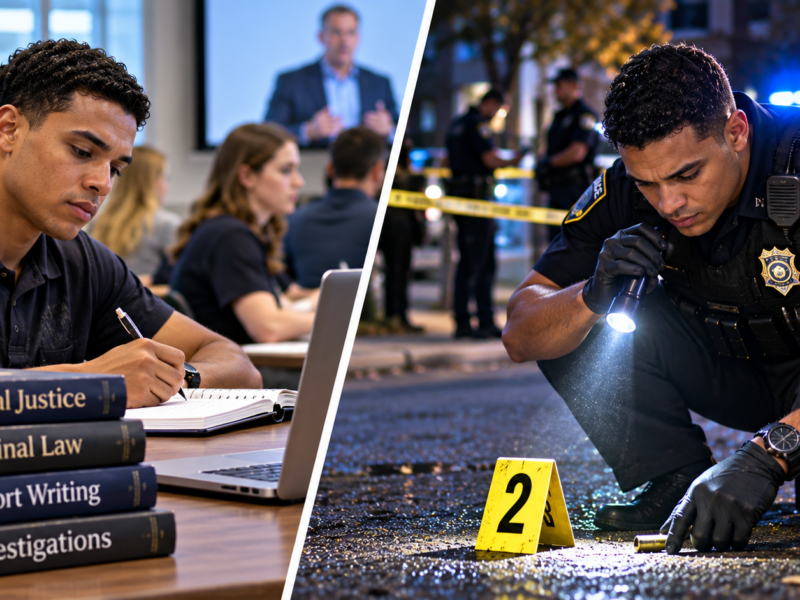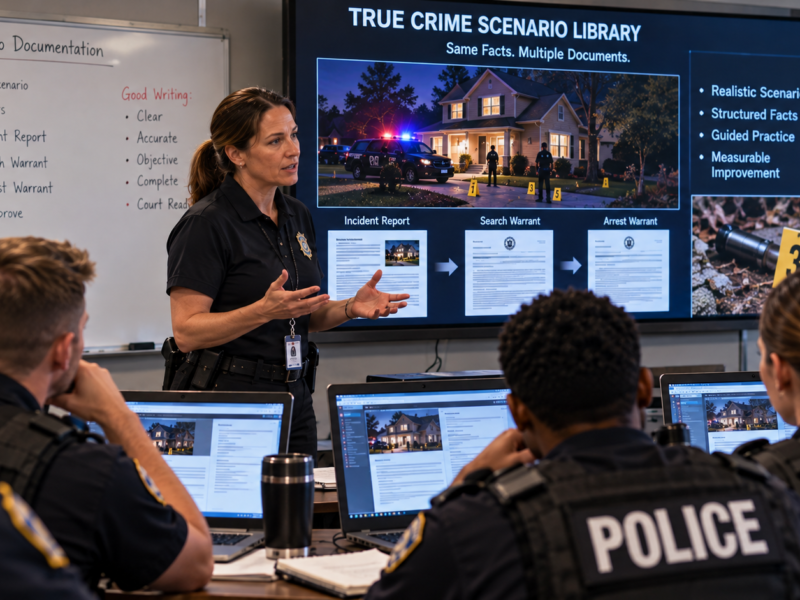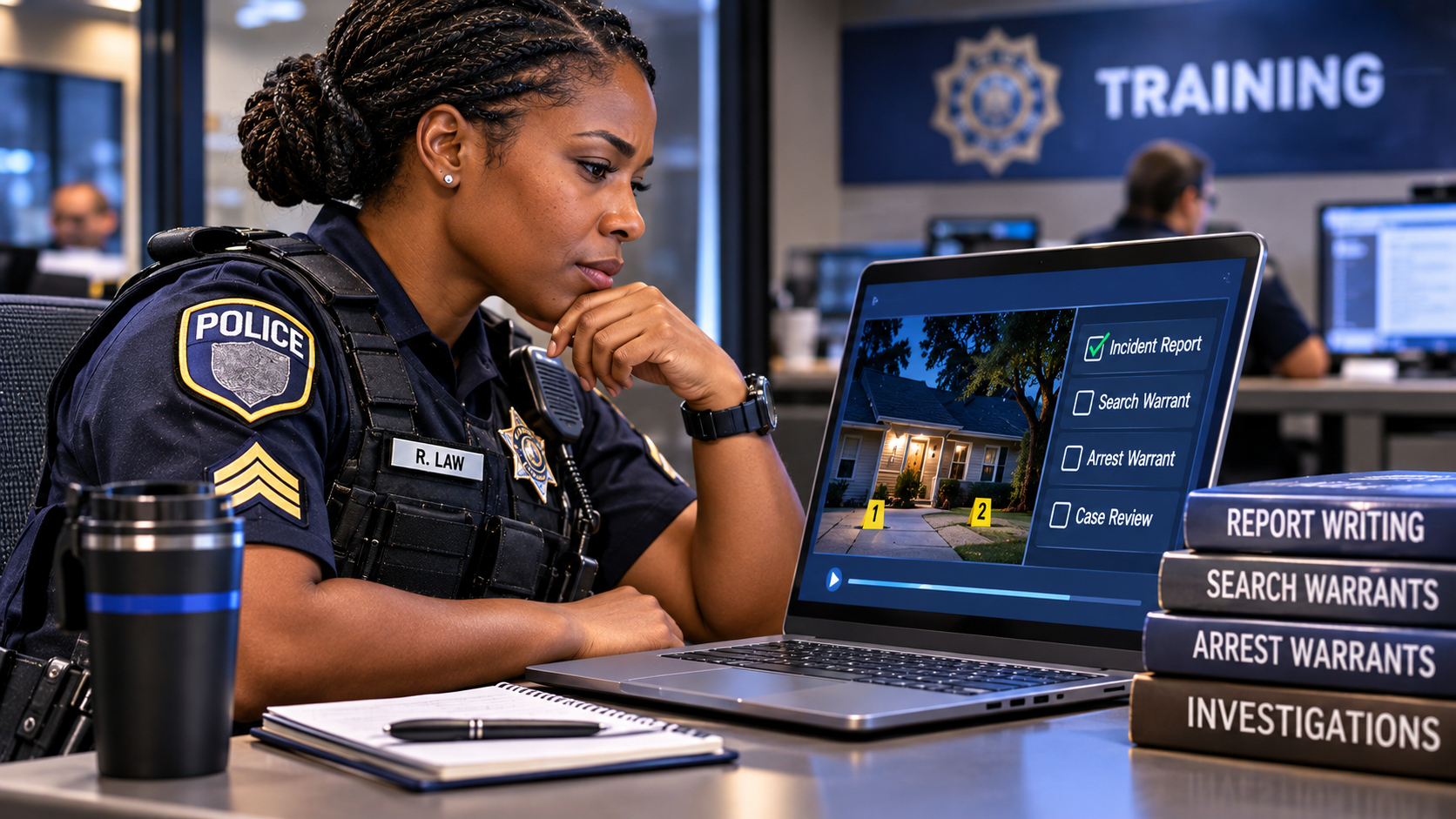
Most officers remember the academy as an intense period of constant instruction, testing, correction, and repetition.
Then graduation happens.
Training does not stop, of course. Agencies continue firearms qualification, legal updates, defensive tactics, communications training, and other required instruction. But officers practice many professional skills less consistently once they become operational.
That raises a useful question: What if police training were treated as a continuous process rather than a series of events?
The U.S. Department of Justice’s COPS Office describes training as an ongoing process that requires continuous self-reflection and evaluation, not a one-time activity (Office of Community Oriented Policing Services [COPS Office], n.d.).
That principle has practical implications.
Officers regularly make decisions involving incomplete information, conflicting accounts, probable cause, evidence, documentation, communication, and judgment. Yet many of these skills are sharpened primarily through actual calls.
Real calls provide experience.
They are not always ideal practice environments.
Learning science suggests that repeated retrieval and spaced practice can strengthen retention and reveal areas that need more work. Research across professional education shows substantial benefits of retrieval and distributed practice over passive review alone (McDermott, 2021; Trumble et al., 2024).
Police training already recognizes this principle in areas where skills can deteriorate. For example, California POST requires continuing professional training and recurring practice in several perishable skill areas.
Investigative judgment and documentation may deserve similar attention.
Imagine an officer completing a short scenario every few weeks:
-A witness changes a statement.
-A timeline contains a gap.
-Evidence points in two directions.
-Probable cause is uncertain.
The officer must decide what the facts support and articulate why.
-No real victim is waiting.
-No arrest depends on the answer.
-No court filing is at stake.
It is simply another opportunity to think.
The objective would not be endless mandatory training.
It would be something more useful: continuous professional practice.
The academy teaches officers how to begin.
Experience teaches them what the job actually demands.
Deliberate practice can help connect the two.
Maybe the future of police training is not another eight-hour classroom course.
Maybe it is creating more opportunities for officers to practice the decisions they already make before the stakes are real.
–Klyvorek & OpenAI
KLYVOREK is a scenario-based training platform that helps officers, investigators, criminal justice students, and other learners strengthen investigative judgment, decision-making, and documentation skills through realistic fictional cases and AI-assisted practice.
References
McDermott, K. B. (2021). Practicing retrieval facilitates learning. Annual Review of Psychology, 72, 609–633.
Office of Community Oriented Policing Services. (n.d.). Training. U.S. Department of Justice.
Trumble, E., et al. (2024). Systematic review of distributed practice and retrieval practice in health professions education. Advances in Health Sciences Education.
United States. (2017). COPS Office Statement on the Extension of Collaborative Reform with the San Francisco Police Department. MENA Report, (), n/a.