Police officers don’t get better at documentation just by being told to “write better reports.”
They improve through repetition, feedback, correction, and another chance to try again.
That raises an important question for law enforcement training: How do we give officers more realistic documentation practice without using real victims, real suspects, sensitive case information, or active investigations?
One answer may be surprisingly simple: Make the case fictional and the learning measurable.
Scenario-based training is already well established in law enforcement. The Police Training Officer model, for example, incorporates problem-based learning and emphasizes developing an officer’s ability to think through problems rather than simply memorize procedures (Office of Community Oriented Policing Services [COPS Office], 2006).
That philosophy extends to documentation.
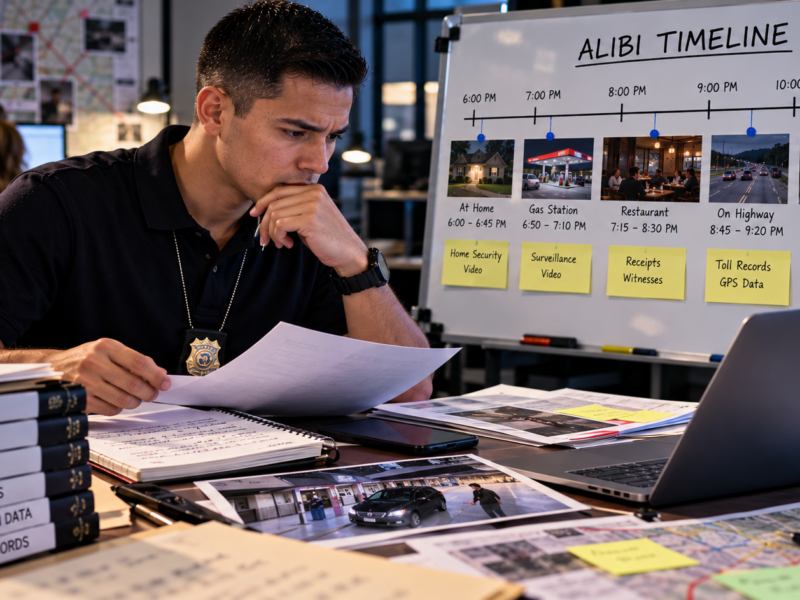
Imagine giving an officer a fictional burglary investigation. Instead of providing every relevant fact on a single page, information unfolds as the investigation progresses.
The officer receives the initial call, observes the scene, interviews a witness, and collects any evidence.
New information may contradict something learned earlier.
The officer must decide what belongs in the report, distinguish facts from assumptions, organize the chronology, and clearly explain what happened.
Also, some questions have to be answered, such as:
-Did the officer identify the important facts?
-Did the narrative maintain chronological clarity?
-Did the officer introduce information that was never provided?
-Were important facts omitted?
If there are mistakes, let the officer revise the report and try another case.
Artificial intelligence creates an interesting opportunity here. But the objective should not be to allow AI to complete the assignment. The COPS Office (2025) emphasizes that AI-assisted police reporting still requires human verification because generated content can be inaccurate.
That limitation can actually become part of the lesson.
A learner using AI assistance should still have to ask: Did AI accurately represent my facts, or did it just make the writing sound better?
This is where fictional fact patterns can go beyond traditional classroom exercises.
Through the KLYVOREK Institute, learners can work through realistic investigative scenarios. Within KLYVOREK, those facts can become the basis for practicing incident reports and drafting search and arrest warrant applications.
The goal isn’t simply to produce a better document.
It is creating something police documentation training often lacks: measurable repetitions.
The safest place to discover that an officer misunderstood the facts is not inside a courtroom; it is inside a scenario.
–Klyvorek & OpenAI
KLYVOREK helps law enforcement professionals strengthen report-writing skills through realistic fictional scenarios, self-paced practice, and AI assistance. The officer provides the facts. KLYVOREK builds the draft. The officer reviews, refines, and improves it.
_____________________________
References
Office of Community Oriented Policing Services. (2006). Police Training Officer (PTO) program: A contemporary approach to post-academy recruit training. U.S. Department of Justice.
Office of Community Oriented Policing Services. (2025). Using AI to write police reports. U.S. Department of Justice.