What if the most valuable police training resource wasn’t another course, but a library officers wanted to revisit?
Law enforcement agencies invest considerable resources in training. Yet many learning experiences follow a familiar pattern: attend instruction, complete an exercise, demonstrate proficiency, and return to duty.
The training ends, but the need to practice doesn’t.
That creates an opportunity for police academies, training divisions, and technology developers: scenario libraries that provide continuing value rather than one-time instruction.
Special operations (SWAT) sections train constantly, but now we’re talking about a different kind of continuous training.
From Training Events to Training Assets
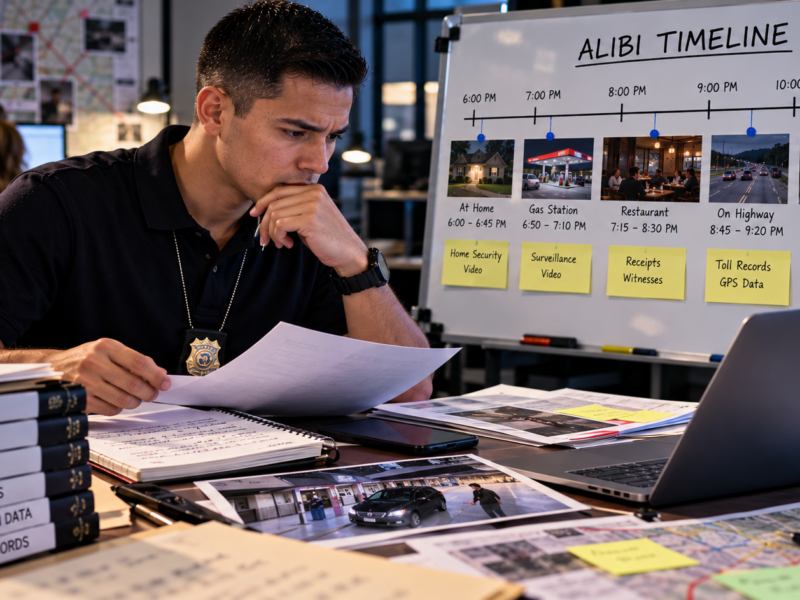
Imagine an expanding collection of fictional investigations involving burglaries, domestic violence, financial crimes, suspicious deaths, and complex search warrant applications.
Each scenario presents an evolving investigation. Participants examine evidence, evaluate conflicting information, make decisions, and prepare documentation.
But the library doesn’t stay static.
New evidence can be introduced. Legal issues can become more complicated. Alternative investigative paths can challenge previous assumptions.
A recruit might complete an introductory scenario during academy training, revisit a more demanding version during field training, and encounter an advanced variation years later.
The same underlying resource supports different stages of professional development.
The Psychology of Repeated Practice
Educational research supports this approach.
Cepeda et al. (2006) found that distributed practice, learning spread across multiple sessions, generally improves long-term retention compared with concentrated practice.
Roediger and Karpicke (2006) demonstrated that retrieving learned information through testing can strengthen later retention.
These findings do not establish that scenario libraries automatically improve police performance. They do suggest why thoughtfully designed, recurring exercises deserve consideration.
The value is not simply having more scenarios. It is giving officers meaningful reasons to return.
From Content Library to Learning Infrastructure
A scenario library could become more useful when instructors can measure performance across repeated exercises.
For example, training personnel could examine whether participants improve in factual accuracy, chronological organization, identification of evidentiary gaps, and documentation of investigative decisions.
Over time, those observations could help identify individual learning needs and recurring weaknesses across training groups.
However, meaningful assessment requires consistent scoring standards, qualified reviewers, and evidence that improvements transfer beyond the exercise.
The Larger Opportunity
The commercial appeal of recurring scenario libraries is understandable. Updated content, progressively difficult exercises, and continuing instructor resources could support subscription-based training models.
But recurring revenue should follow recurring educational value, not substitute for it.
The strongest training library would not be the one with the largest collection of cases.
It would be the one that helps officers return, practice, receive meaningful feedback, and demonstrate improvement.
The future of police training may depend less on how many courses officers complete, and more on how often they meaningfully practice what those courses were supposed to teach.
–Klyvorek & OpenAI
KLYVOREK helps law enforcement professionals strengthen report-writing skills through realistic fictional scenarios, self-paced practice, and AI assistance. The officer provides the facts. KLYVOREK builds the draft. The officer reviews, refines, and improves it.
_____________________________________
References
Cepeda, N. J., Pashler, H., Vul, E., Wixted, J. T., & Rohrer, D. (2006). Distributed practice in verbal recall tasks: A review and quantitative synthesis. Psychological Bulletin, 132(3), 354–380. https://doi.org/10.1037/0033-2909.132.3.354.
Psychology in the Classroom: Recall or Re-read? The research into retrieval practice. https://changingstatesofmind.libsyn.com/website/recall-or-re-read-the-research-into-retrieval-practice.
Roediger, H. L., III, & Karpicke, J. D. (2006). Test-enhanced learning: Taking memory tests improves long-term retention. Psychological Science, 17(3), 249–255. https://doi.org/10.1111/j.1467-9280.2006.01693.x.