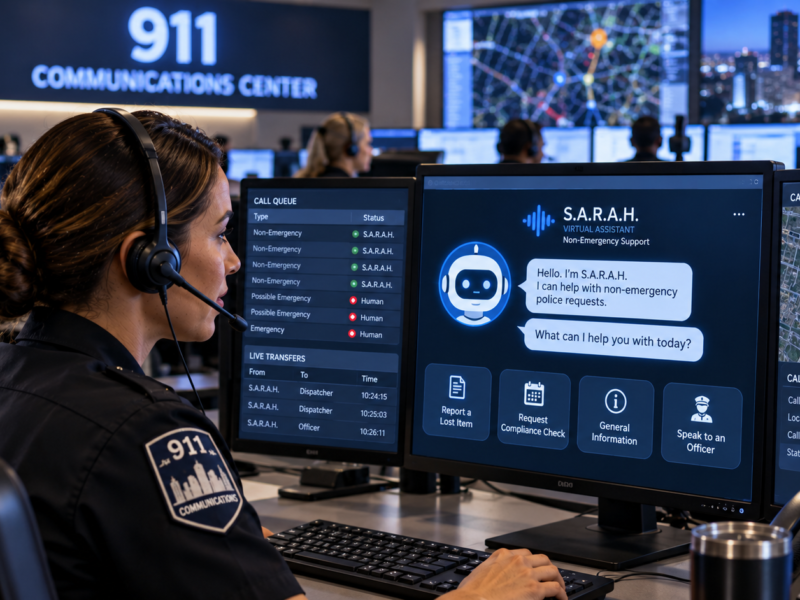
For many police departments, the first meaningful encounter with generative artificial intelligence may be report writing.
Police reports are time-consuming, officers’ writing ability varies, and supervisors routinely review reports for clarity, completeness, and organization. AI can potentially help transform officer-provided facts into clearer documentation.
But focusing exclusively on report writing may cause law enforcement to miss the larger opportunity.
The future isn’t AI report writing; it is AI-assisted documentation.
Consider how much of policing involves converting information into structured documents.
An investigator collects facts and prepares a search warrant application.
An officer establishes probable cause and prepares an arrest warrant application.
Detectives organize supplemental reports, interview summaries, evidence descriptions, timelines, and investigative notes.
Supervisors document performance issues, critical incidents, administrative investigations, and policy decisions.
Training officers complete evaluations. Commanders prepare after-action reports. Agencies respond to public records requests and compile operational summaries.
The common denominator isn’t artificial intelligence; it is documentation.
Research already suggests generative AI has applications across policing beyond report generation, while emphasizing the importance of governance, human oversight, transparency, and accountability (Halford, 2025). The National Institute of Standards and Technology (NIST, 2023) similarly emphasizes managing AI risks throughout the technology’s lifecycle rather than treating AI as an autonomous decision-maker.
This suggests a different question for police executives.
Instead of asking: “Where can AI write for us?”
Ask: “Where are trained personnel spending time converting information they already possess into required documentation?”
That distinction matters.
AI should not determine probable cause, invent evidence, decide what an officer observed, manufacture witness statements, or substitute its judgment for the professional judgment of law enforcement personnel.
A more defensible model is:
Human provides information → AI assists with structure → Human verifies → Human remains accountable.
That philosophy is behind platforms such as KLYVOREK, which currently focuses on incident reports and structured search and arrest warrant application drafts.
But those documents may represent only the beginning of the category.
The long-term opportunity could include investigative summaries, supplemental narratives, case chronologies, supervisory documentation, training records, after-action reports, and other structured law enforcement documents, provided each use case is appropriate, secure, governed, and subject to meaningful human review.
The departments that benefit most from AI may therefore not be those asking:
“How much can AI do?”
They may be the ones asking: “Which administrative burdens can technology responsibly remove without removing human judgment?”
That is a much bigger conversation than police report writing.
And it may define the next generation of law enforcement documentation.
–Klyvorek & OpenAI
KLYVOREK, a division of the American Academy of Advanced Thinking, LLC, is an AI-assisted law enforcement documentation platform that helps officers create clear, structured incident reports and draft search and arrest warrant applications, while keeping the officer in control of the final document.
______________________________________________________
References
Halford, E. (2025). The Transformer Led Policing model: A framework for applying generative artificial intelligence in policing. Policing: A Journal of Policy and Practice, 19, paaf027.
National Institute of Standards and Technology. (2023). Artificial intelligence risk management framework (AI RMF 1.0). U.S. Department of Commerce.
Pinnaka, P. (2026). Case Study : A Practitioner’s Framework for Evaluating Agentic AI Use Cases in Supply Chain Operations. IISE Annual Conference. Proceedings, (), 1-7.