When people picture a police investigation, they often picture detectives arriving after the scene has been secured.
But many investigations begin much earlier.
They begin with the patrol officer who gets there first.
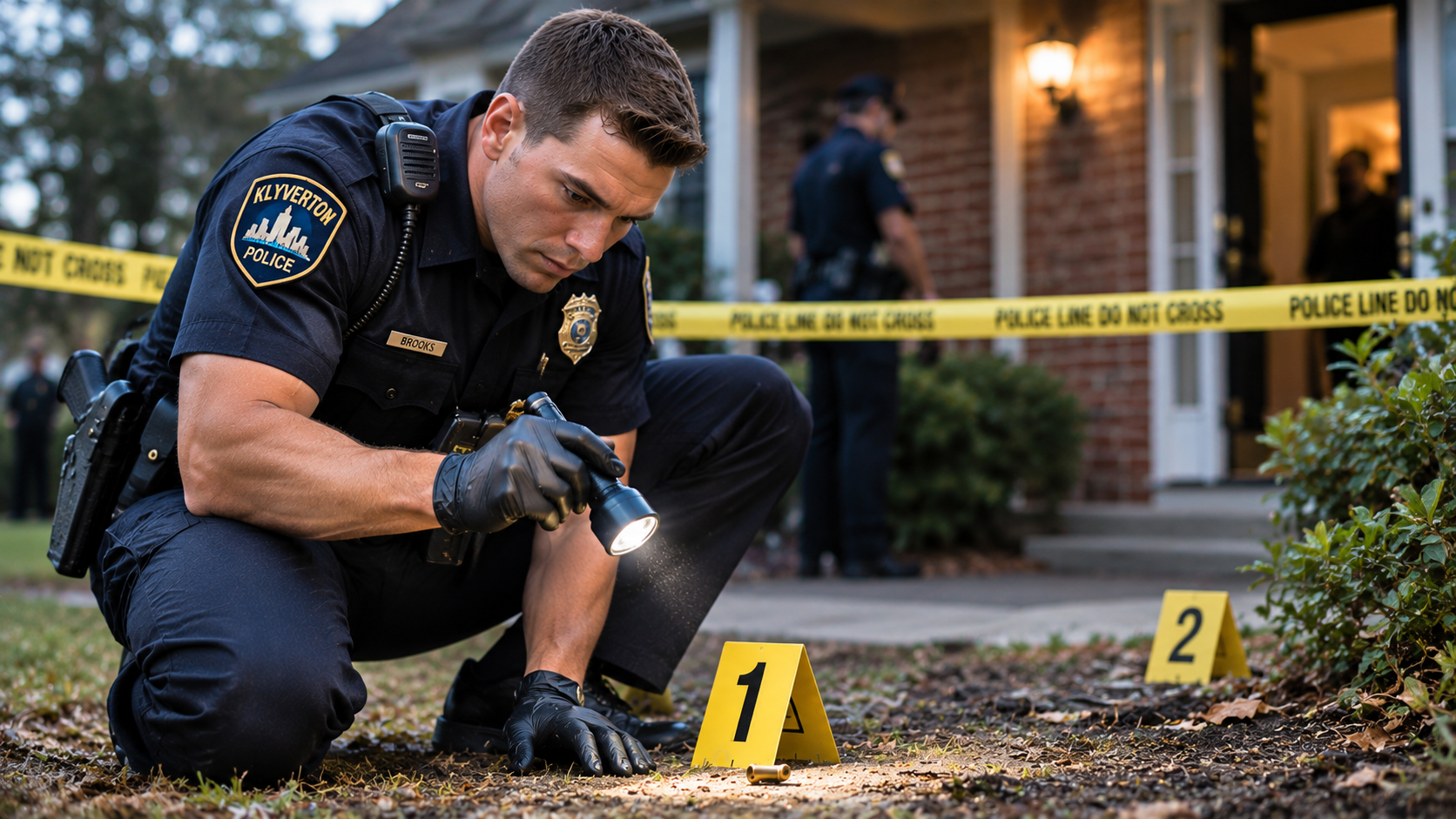
That officer may be the first to see the scene before it changes, hear a witness before stories begin to blend together, notice evidence before it is moved, or recognize that something does not fit. Those early observations and decisions can shape the entire investigation.
The National Institute of Justice has emphasized the importance of first responders in protecting scenes, preserving physical evidence, controlling people at the scene, documenting observations, and transferring information to investigators (National Institute of Justice, 2013).
That makes patrol more than the front end of enforcement.
It makes patrol the first investigative link.
This idea has important implications for police academy training.
Basic training must certainly teach recruits law, policy, tactics, communication, and procedure. But recruits also need opportunities to practice how those concepts come together when facts are incomplete, and conditions are changing.
Knowing what to do is different from recognizing when, why, and how to do it.
Research on police education supports training approaches that move beyond passive instruction and give recruits opportunities to apply knowledge through realistic cases, scenarios, role-playing, feedback, and repetition (Kruis et al., 2023; O’Neill et al., 2019).
Scenario-based learning is particularly useful because police work rarely unfolds in a predictable sequence.
A recruit may know that witnesses should be separated. But does the recruit recognize why that matters when several people are standing together at a chaotic scene?
NIJ guidance on eyewitness evidence has long cautioned that witnesses can influence one another when they hear other accounts, potentially affecting the independence of later statements (National Institute of Justice, 2003).
A recruit may also understand the importance of evidence preservation. But can that recruit recognize what might disappear, what may have been moved, or what detail should be documented before the scene changes?
These are cognitive skills that involve attention, interpretation, prioritization, judgment, and communication.
And they can be practiced.
Research involving police recruits has shown that interactive training methods can improve observable behavior. Rosenbaum and Lawrence (2017), for example, found that recruits receiving procedural justice and communication training involving role-playing, repeated practice, and feedback demonstrated stronger interpersonal behaviors during simulated encounters.
Simulation can also strengthen applied performance. Lavoie et al. (2023) found that both virtual reality and live-action scenario training improved de-escalation competencies when compared with a control condition.
The larger lesson is that training should not stop at whether a recruit can recall a rule on an examination.
It should also ask:
- Can recruits recognize the relevant fact?
- Can they identify what remains unknown?
- Can recruits preserve what matters?
- Can they explain why they made a decision?
- Can they document the scene clearly enough that another investigator can understand what happened later?
Role-playing and scenario exercises are especially valuable because they create a controlled environment where mistakes can become lessons instead of case consequences.
A recruit can miss a contradiction, overlook an important observation, or poorly explain a decision, and then receive feedback, review the performance, and try again.
That is difficult to replicate through lecture alone.
This does not mean every patrol officer must become a detective.
It means recruits should understand that the investigation often starts before a detective ever arrives.
The detective may eventually build the case, but the patrol officer frequently determines what the detective has left to build with.
That is why police training should develop investigative thinking from the beginning.
Not only: What should I do?
But also: What do I know?
How do I know it?
What could disappear?
What should I document now?
And what will the next investigator need from me?
The case may begin with a dispatch call, and the investigation may begin with the first officer through the door.
And sometimes, the first five minutes matter more than the next five hours.
Klyvorek & OpenAI
KLYVOREK is a scenario-based training platform that helps Criminal Justice Programs, Police Academies, FTOs, and individual learners strengthen investigative judgment, decision-making, and police documentation through realistic fictional cases and AI-assisted practice.
______________________________
References
Kruis, N. E., Choi, J., & Donohue, R. H. (2023). The case for case-based learning in police recruit training. The Police Journal: Theory, Practice and Principles. https://doi.org/10.1177/0032258X231181322.
Lavoie, J., Álvarez, N., Baker, V., & Kohl, J. (2023). Training police to de-escalate mental health crisis situations: Comparing virtual reality and live-action scenario-based approaches. Policing: A Journal of Policy and Practice, 17, 1–12. https://doi.org/10.1093/police/paad069.
National Institute of Justice. (2003). Eyewitness evidence: A trainer’s manual for law enforcement. U.S. Department of Justice.
National Institute of Justice. (2013). Crime scene investigation: A guide for law enforcement. U.S. Department of Justice.
O’Neill, J., O’Neill, D. A., Weed, K., Hartman, M. E., Spence, W., & Lewinski, W. J. (2019). Police academy training, performance, and learning. Behavior Analysis in Practice, 12, 353–372.
Rosenbaum, D. P., & Lawrence, D. S. (2017). Teaching procedural justice and communication skills during police-community encounters: Results of a randomized controlled trial with police recruits. Journal of Experimental Criminology, 13(3), 293–319. https://doi.org/10.1007/s11292-017-9293-3.