Police chiefs usually know what their technology costs.
They can see the annual software contract, licensing fees, maintenance costs, and implementation expenses.
But another technology cost rarely appears in the budget: officer time.
Recent evidence suggests that this hidden expense deserves greater attention.
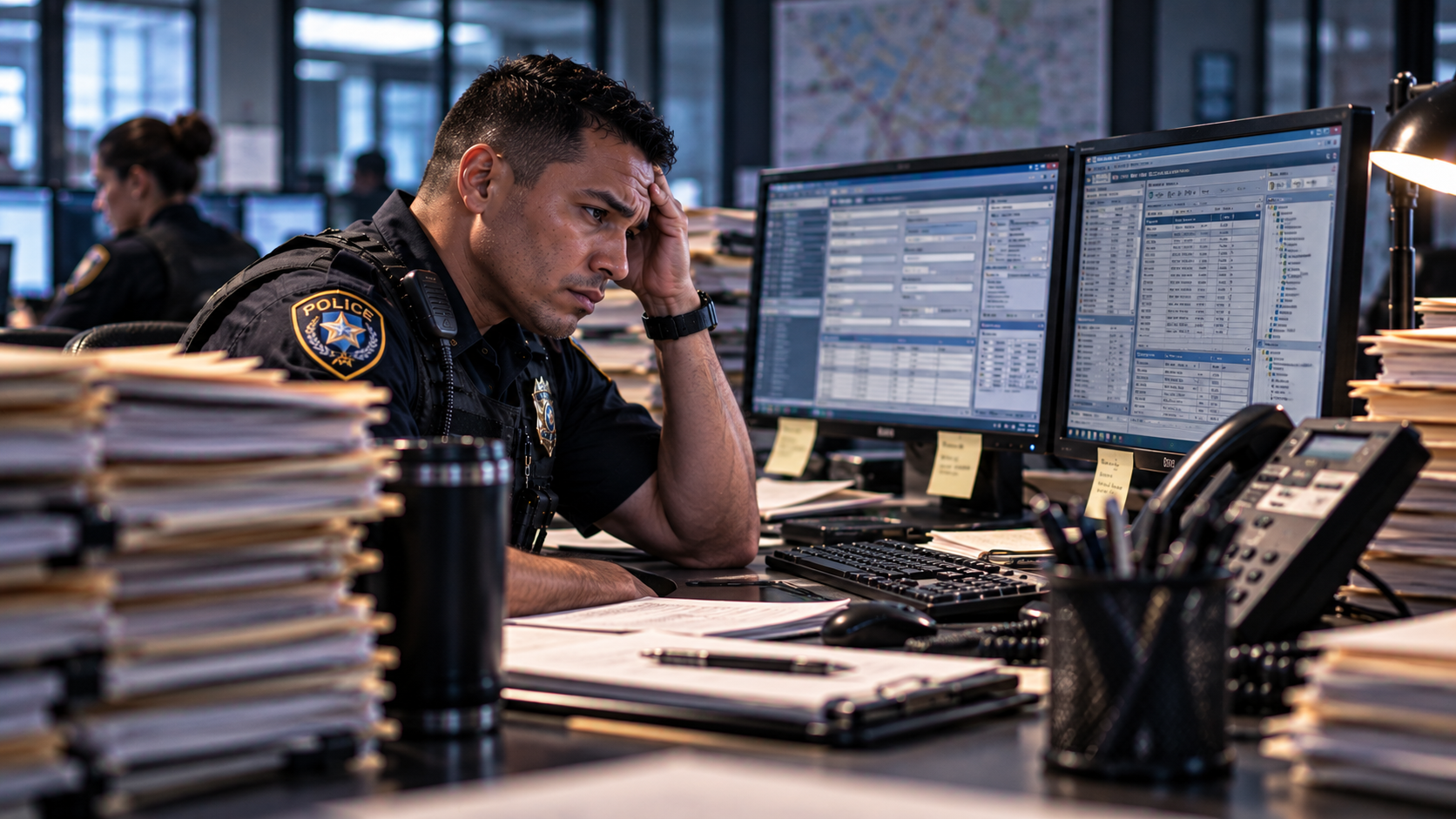
Police1’s What Cops Want in 2026 survey included 1,777 patrol officers. Officers described technology that requires duplicate data entry, disconnected systems, unreliable platforms, and repetitive administrative work. Nearly one-third reported having 15% or less of their shifts available for proactive policing. Report and administrative workloads were identified as one of the major barriers to proactive work (Police1, 2026).
That creates a different way to think about police technology.
A records-management system might have a reasonable annual contract price.
But what if officers repeatedly enter the same information into CAD, RMS, evidence, body-camera, and arrest systems?
What if they must return to the station because the system does not work effectively in the field?
What if supervisors spend additional time correcting workflow problems created by the software itself?
Those minutes accumulate.
A 2026 Audit Office of New South Wales review documented exactly these problems within police legacy systems. Investigators found duplicate data entry, poor system integration, paper-based workarounds, outdated interfaces, and officers moving among multiple systems to complete routine tasks. The audit concluded that legacy technology was reducing operational efficiency while creating additional financial and technological risk (Audit Office of New South Wales, 2026).
Perhaps chiefs need another technology metric: Administrative Minutes per Officer per Shift.
Instead of asking only:
“What does this software cost?”
Ask:
“How much officer time does this software consume?”
Even 15 unnecessary minutes, multiplied across officers, shifts, weeks, and years, can quietly become hundreds or thousands of personnel hours.
That does not mean every older system should be replaced.
New technology can create its own costs, training problems, implementation failures, and vendor dependencies.
The larger point is simpler.
Police departments should evaluate technology according to total operational cost, not merely contract price.
Sometimes the most expensive software is not the new system a chief is considering.
It is the inefficient system everyone has learned to tolerate.
–Klyvorek & OpenAI
KLYVOREK, a division of the American Academy of Advanced Thinking, LLC, is an AI-assisted law enforcement documentation platform that helps officers create clear, structured incident reports and draft search and arrest warrant applications, while keeping the officer in control of the final document.
________________________________
References
Audit Office of New South Wales. (2026). Upgrades to core policing technology. Government of New South Wales.
Police1. (2026, September 10). Give patrol time back: What officers want from the technology they use every shift.
Police1. (2026, September 12). Report writing is reshaping the patrol shift.