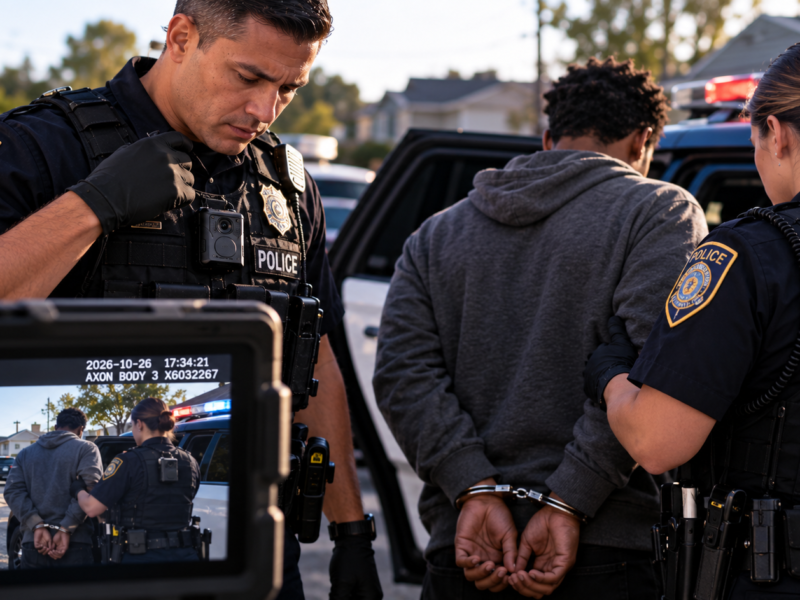
The report reads smoothly. The timeline appears logical. The suspect’s behavior seems suspicious.
Then someone asks: “What facts support that conclusion?”
Suddenly, the case looks different.
Police documentation requires more than describing events. It requires distinguishing observations from assumptions, identifying information sources, and recognizing what remains unknown. A convincing narrative can still contain an incomplete investigation.
Consider a fictional burglary. A witness reports seeing a man leave a residence carrying a television. An officer locates someone nearby matching the description.
What is still missing?
Did the witness actually see the person exit the residence? How specific was the description? Who owns the television? Did anyone have permission to remove it? Are the times consistent? What information might contradict the initial explanation?
These questions reveal the difference between having a theory and testing one.
The College of Policing (n.d.) recommends an investigative approach that challenges assumptions and evaluates available material. Although this guidance comes from the United Kingdom, its emphasis on questioning initial explanations offers a useful training principle: confidence should invite verification.
Artificial intelligence makes this distinction especially important.
An AI-generated draft may organize supplied information into polished paragraphs while leaving underlying gaps unresolved. The National Institute of Standards and Technology (2024) identifies confidently presented false content, or confabulation, as a generative AI risk. Fluent writing therefore cannot serve as evidence that the facts are accurate or complete.
For instructors, this creates a practical opportunity.
Give learners the same fictional incident. Ask them to identify established facts, unresolved questions, conflicting information, and reasonable next steps before drafting a report. Then review whether their writing preserves those distinctions.
The exercise should reward justified uncertainty. “The available information does not establish this” can demonstrate stronger reasoning than a confident statement unsupported by the scenario.
A useful review asks four questions:
- What do you know?
- How do you know it?
- What remains uncertain?
- What would help resolve that uncertainty?
That is the training purpose behind KLYVOREK Institute’s fictional scenarios: to let participants practice examining facts and developing documentation before real consequences are involved.
The goal is a clearer account of what the information supports, where its limits lie, and which questions deserve further attention.
Before submitting your next practice report, pause at your strongest conclusion. Underline every fact supporting it. Then identify the question you have not answered.
Can you make your case, and recognize what is still missing? Try a case at Klyvorek.com.
____________________________________________
References
College of Policing. (n.d.). Investigation process. https://www.college.police.uk/app/investigation/investigation-process.
National Institute of Standards and Technology. (2024). Artificial intelligence risk management framework: Generative artificial intelligence profile (NIST AI 600-1). https://doi.org/10.6028/NIST.AI.600-1.