You have identified a suspect. You know where the suspect lives. You believe stolen property may be inside.
What connects those facts?
That question belongs at the start of search warrant training. Before learners draft an affidavit, they should assess whether the available information explains why particular evidence would be in the place they propose searching.
In Illinois v. Gates (1983), the Supreme Court described a practical assessment of the totality of the circumstances: whether there is a fair probability that evidence or contraband will be found in a particular place. The inquiry requires evaluating the circumstances presented.
Consider a fictional burglary investigation.
A camera records a person carrying a distinctive equipment case from a business. Investigators identify a possible suspect and locate a residential address.
The address provides a location. What information connects the equipment case to that location?
Did someone observe the suspect carrying it inside? Is there corroborated information about where it was stored? How much time has passed? What reasonable inferences arise from the circumstances, and what assumptions remain unsupported?
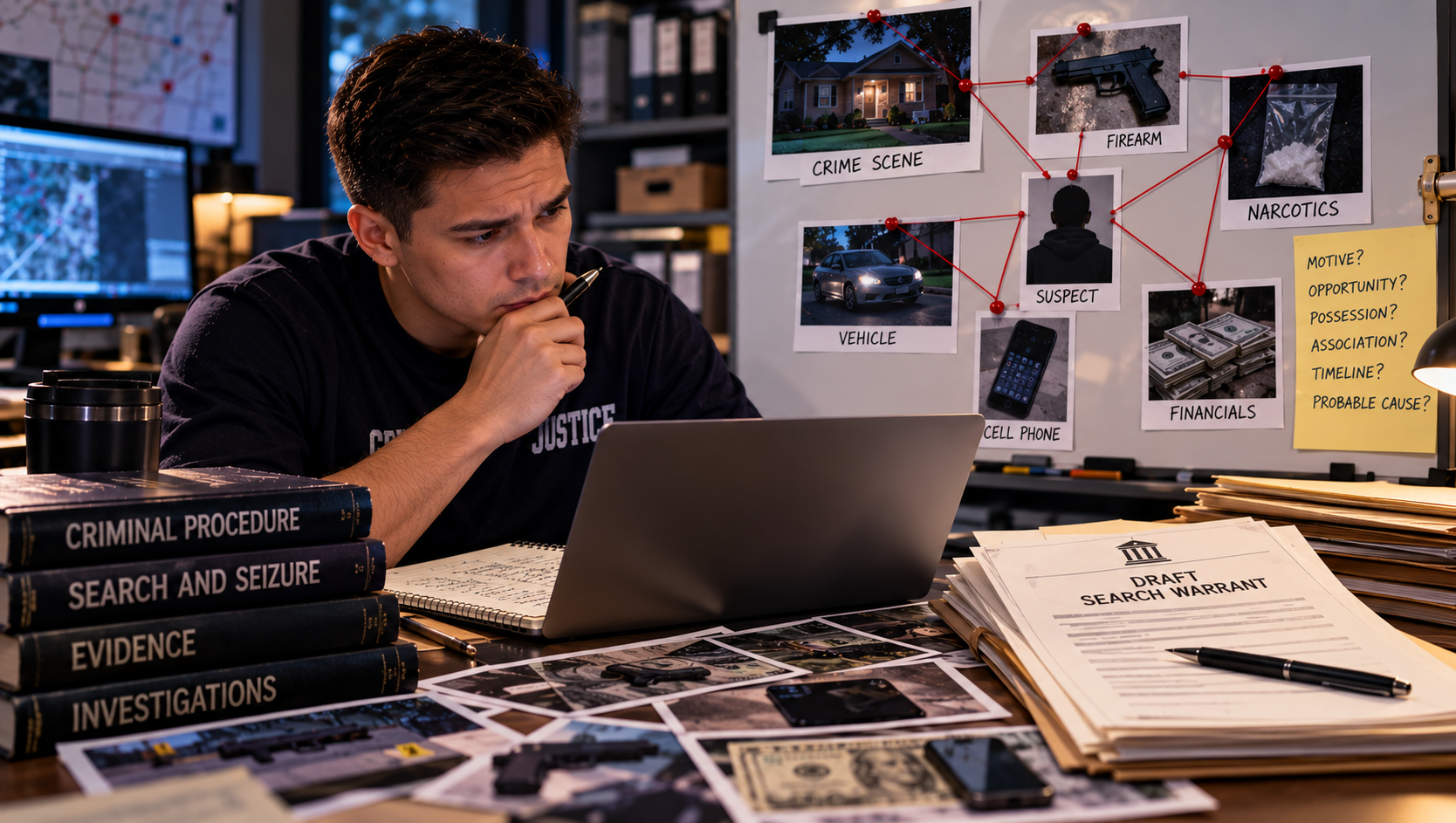
The connection is often called the nexus. Alameda County District Attorney’s Office (2021) explains that probable cause to search requires a connection between the evidence sought and the location to be searched. That connection deserves explicit attention during training.
For academy instructors and criminal justice faculty, this suggests an exercise: pause the writing.
Ask learners to separate their work into three categories: established facts, reasonable inferences, and unanswered questions. Require them to identify the source of each fact and explain the reasoning behind each inference.
Then introduce another detail that challenges their initial theory.
Can they revise their reasoning? Can they recognize when they need additional investigation? Can they explain what the evidence supports without making the narrative more certain than the facts allow?
AI assistance makes this discipline especially valuable. A drafting tool can organize supplied information, but learners must still examine whether its wording accurately reflects the scenario. Any unsupported connection should remain a question to investigate.
KLYVOREK Institute’s fictional scenarios offer an opportunity to practice that reasoning before real consequences arise. Instructors can adapt exercises to applicable law, local requirements, and agency procedures.
The training objective is clear: participants should explain why they seek particular evidence in a particular place.
Before you draft your next practice affidavit, draw the connection in plain language. Which fact supports it? Which inference requires explanation? What information is still missing?
Klyvorek & OpenAI
KLYVOREK helps law enforcement professionals strengthen report-writing and documentation skills through realistic fictional scenarios, self-paced practice, and AI assistance. The officer provides the facts. KLYVOREK builds the draft. The officer reviews, refines, and improves it.
__________________________________
References
Alameda County District Attorney’s Office. (2021). Probable cause to search: The “nexus” requirement. Point of View, Spring–Summer. https://le.alcoda.org/publications/point_of_view/files/AAZZ_SS21_NEXUS.pdf.
Illinois v. Gates, 462 U.S. 213 (1983). https://www.law.cornell.edu/supremecourt/text/462/213.