Don’t treat an alibi as something investigators must disprove.
Treat it as a claim that must be mapped, tested, and documented objectively.
The starting point is time.
Ask the person to account for the relevant period surrounding the offense, not merely the exact minute the crime occurred. Where were they? When did they arrive? When did they leave? Who saw them? How did they travel? What happened immediately before and afterward?
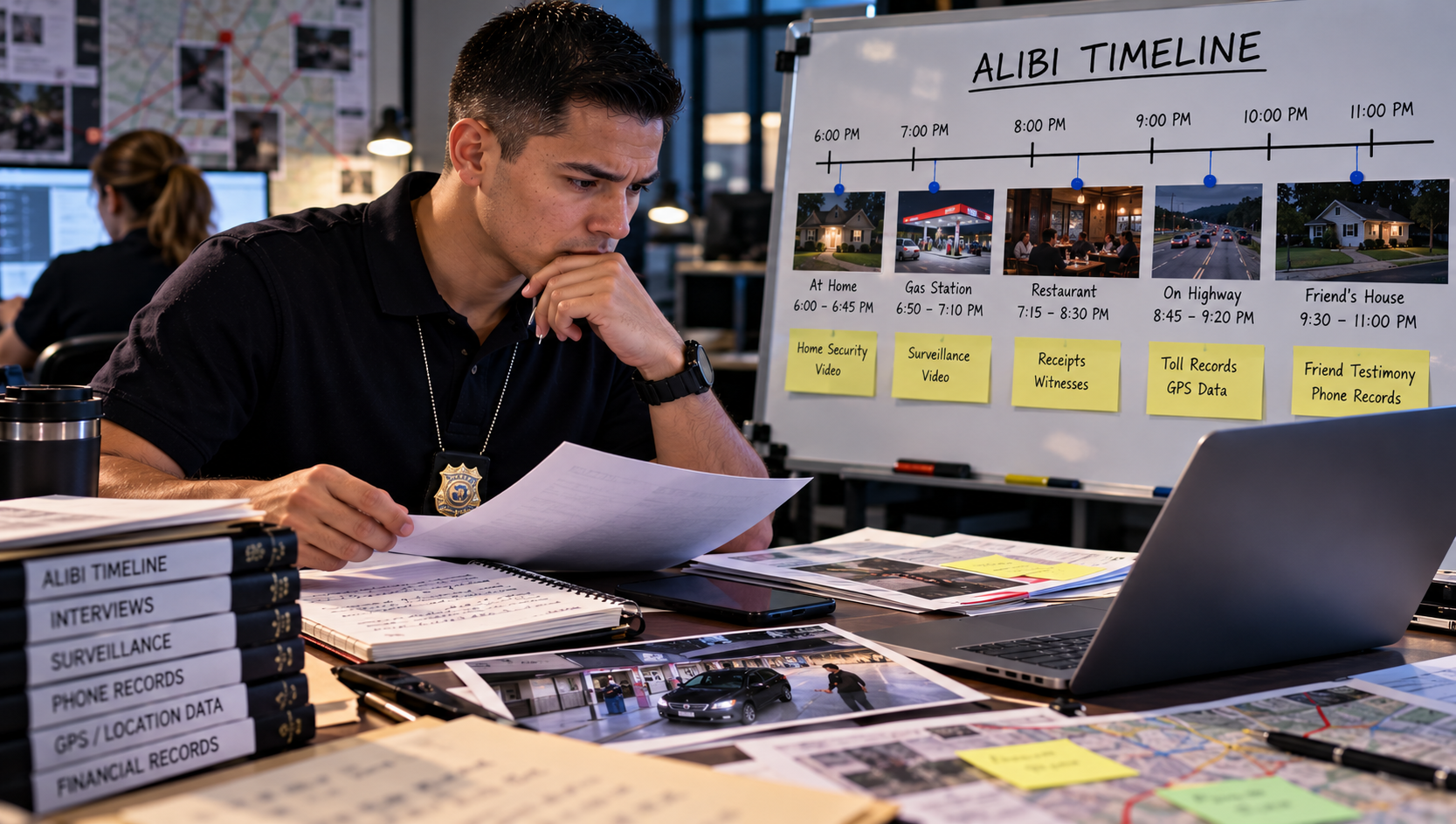
Then construct a simple chronological timeline.
4:45 p.m. — Leaves workplace
5:10 p.m. — Arrives at restaurant
5:35 p.m. — Leaves restaurant
6:05 p.m. — Arrives home
At first, these are claims, not established facts.
The investigator’s job is to identify what information could independently corroborate or contradict each point.
The National Institute of Justice has emphasized carefully collecting and documenting witness information, including assessing each element of a statement rather than treating the account as a single block of information (National Institute of Justice [NIJ], 2003).
Potential corroboration may include witnesses, lawful access to video, transaction records, employment records, communications, or other relevant evidence. Historical investigative guidance similarly recommends documenting a suspect’s location over the relevant period and promptly following up on identified alibi witnesses and supporting information.
The critical discipline is avoiding confirmation bias.
Do not ask only: What disproves this alibi?
Also ask: What would confirm it?
If evidence supports the person’s account, document it with the same care you use for contradictions.
Digital evidence can be particularly useful, but interpret timestamps carefully. Investigators should document when they collected the evidence, how they preserved it, and any relevant time zone or system considerations.
A useful alibi timeline therefore contains three layers:
Claim → Corroboration → Assessment
The final assessment may be:
- Corroborated
- Partially corroborated
- Contradicted
or simply: Unable to verify
That last category matters.
Good investigation does not force uncertainty into certainty.
An alibi timeline is not primarily a tool for proving someone lied.
It answers a more professional question: Where does the evidence place this person during the time that matters?
Investigators should be prepared to explain that standard in the report to a prosecutor, and ultimately in court.
Klyvorek & OpenAI
KLYVOREK helps law enforcement professionals strengthen report-writing and documentation skills through realistic fictional scenarios, self-paced practice, and AI assistance. The officer provides the facts. KLYVOREK builds the draft. The officer reviews, refines, and improves it.
_________________________________________
References
National Institute of Justice. (2003). Eyewitness evidence: A trainer’s manual for law enforcement.
National Institute of Justice. (2023). DNA: A prosecutor’s practice notebook—Confessions.
U.S. Department of Justice. (2005). Digital evidence in the courtroom: A guide for law enforcement and prosecutors.