For decades, police training has used role-playing to prepare officers for traffic stops, domestic disputes, crisis encounters, and use-of-force decisions. But once the scenario ends, police often treat one of the most consequential parts of the work very differently: the documentation.
That may be changing.
Artificial intelligence, interactive simulation, and game-based learning are beginning to converge around a new possibility: officers could repeatedly practice not only what they would do, but how they would document and articulate why they did it.
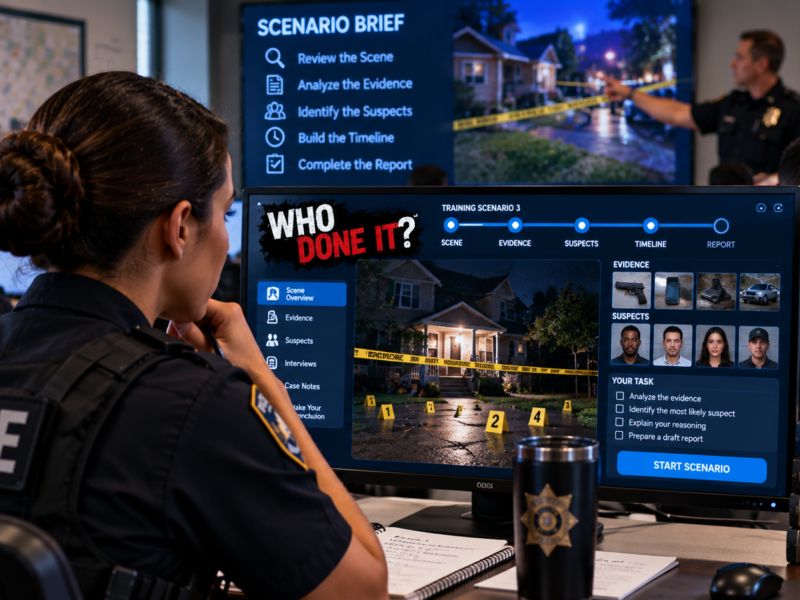
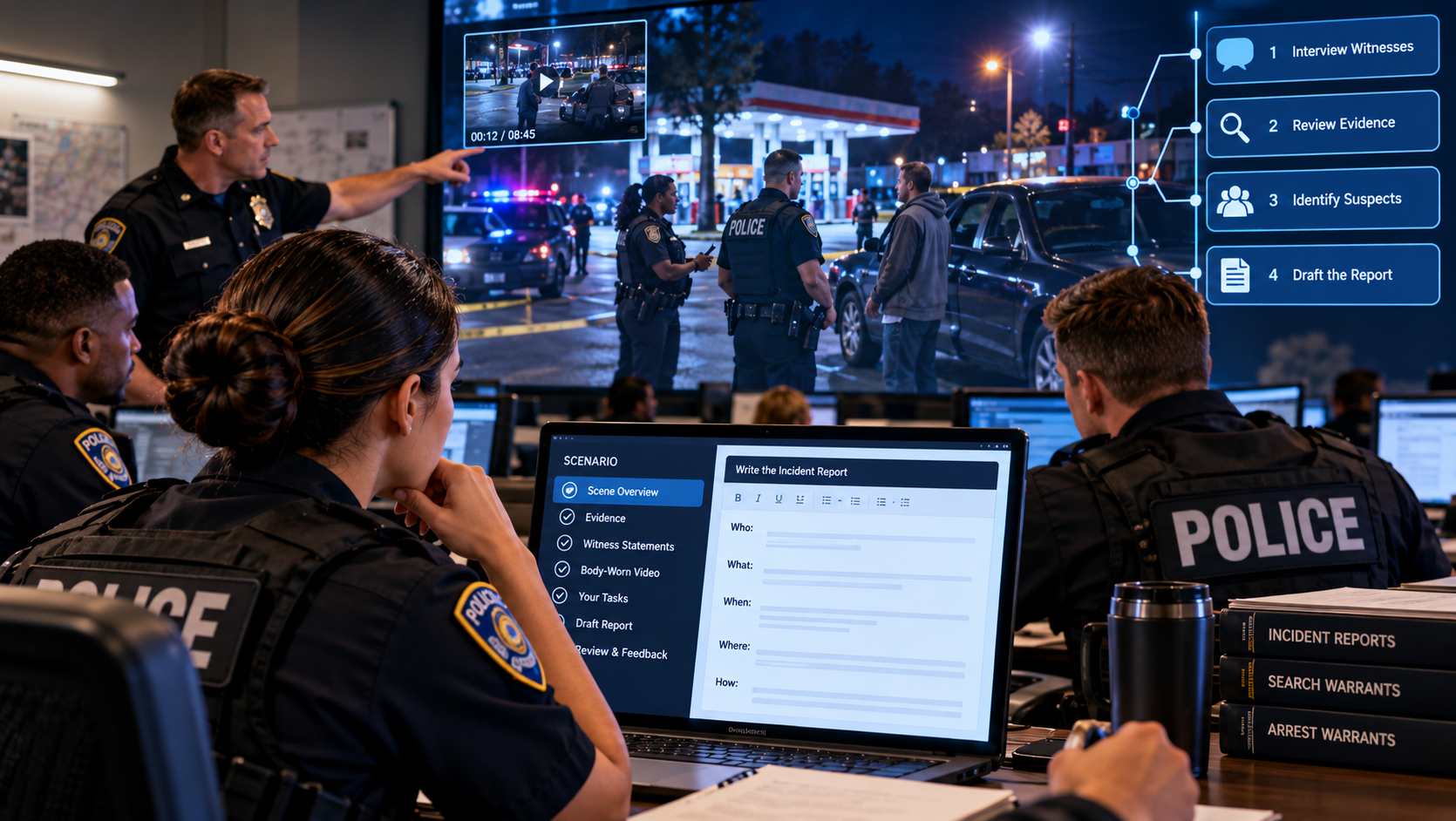
Imagine receiving a fictional burglary call rather than a blank report-writing exercise. You review dispatch information, examine photographs, interview simulated witnesses, identify inconsistencies, and decide what investigative steps to take.
Then you write the report.
In another scenario, an investigator receives an evolving case file containing witness statements, digital evidence, photographs, and conflicting information. The objective is not simply to “win” the scenario. The investigator must determine whether the available facts establish probable cause and, if appropriate, draft the warrant application.
AI could make these exercises increasingly dynamic by supporting interactive characters, scenario variation, and individualized feedback. Recent policing scholarship has identified AI, simulation, and games as technologies that can expand scenario creation and automated feedback (Silvestri & Silika, 2026).
The underlying concept is not entirely new. National Institute of Justice-sponsored research has examined low-cost, game-based virtual training that allows officers to repeatedly practice decision-making in controlled environments (Lewis & Hartholt, 2020; Marler & Straus, 2024).
An emerging opportunity is to extend that philosophy to police documentation and legal articulation.
A report-writing class can explain what belongs in a report. A warrant class can explain probable cause. Scenario-based documentation training can challenge officers to find relevant facts, distinguish observation from inference, make a decision, write it, receive feedback, and try again.
The technology should not merely determine whether an officer’s reasoning is legally correct, nor should AI write the exercise for the officer. Human judgment, current law, agency policy, instructors, and supervisory review remain essential.
The better model may be simpler: The officer provides the facts. AI creates the draft. And the officer remains responsible.
For department leaders, the opportunity is not to turn police training into a video game.
It is to make deliberate practice more accessible.
The question for police leaders is becoming: If officers can practice consequential physical decisions repeatedly before facing them in the field, why shouldn’t we create the same opportunity for the reports and warrants that must explain those decisions afterward?
Klyvorek & OpenAI
KLYVOREK helps law enforcement professionals strengthen report-writing skills through realistic fictional scenarios, self-paced practice, and AI assistance.
_________________________________
References
Lewis, M. W., & Hartholt, A. (2020). Effective game-based training for police officer decision-making: Linking missions, skills, and virtual content. Office of Justice Programs.
Marler, T., & Straus, S. (2024). Improved officer decision-making and stress management with virtual environments. Office of Justice Programs.
Maathuis, C. (2024). Design Framework for VR Games in the Police Domain. European Conference on Games Based Learning, (), 571-579.
Silvestri, C., & Silika, K. K. (2026). Training the future of policing: Can immersive simulation, games, and AI provide valuable assets? An opinion piece. Policing: A Journal of Policy and Practice, 20, paag023. https://doi.org/10.1093/police/paag023.