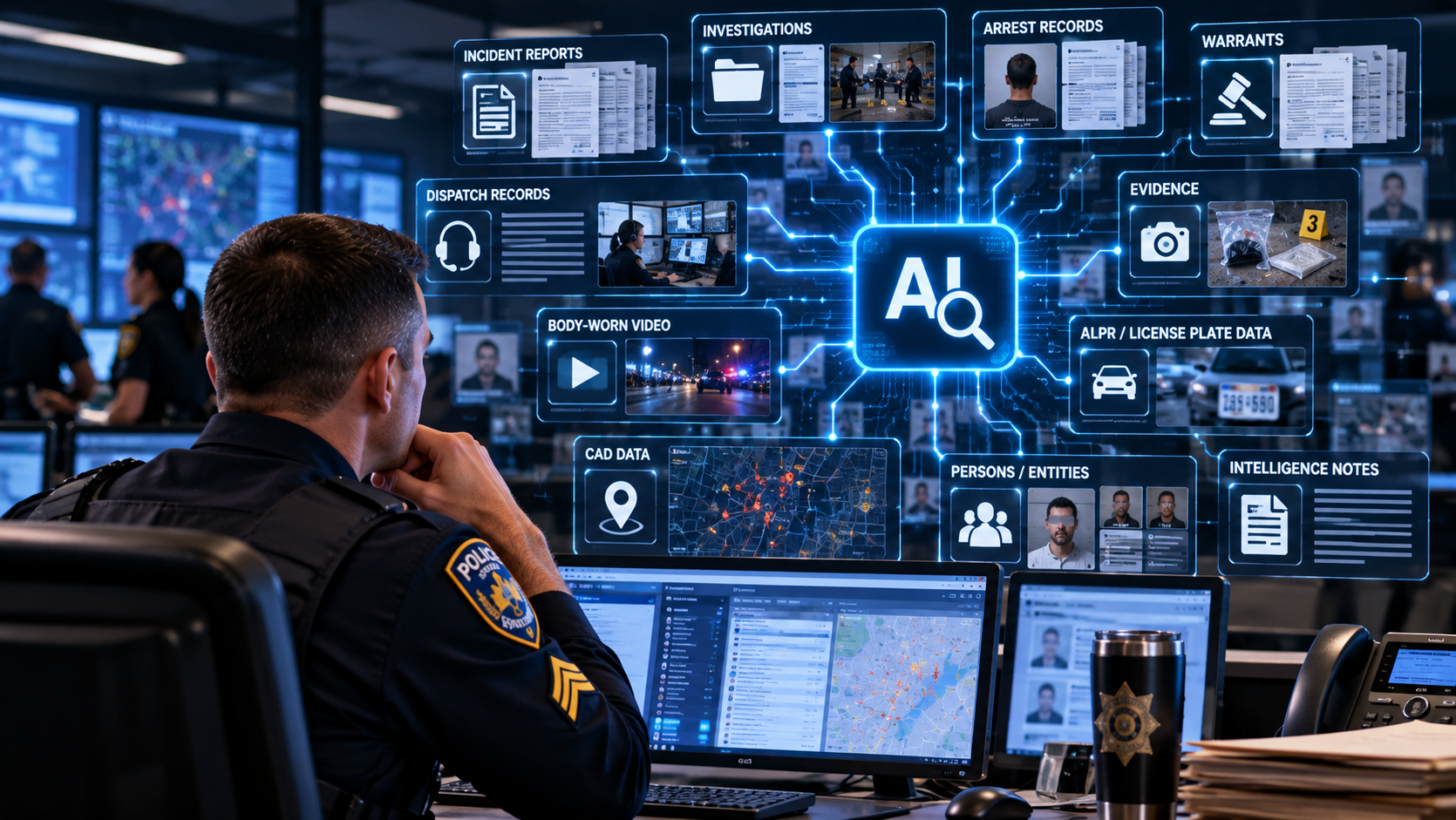
Police departments already possess enormous amounts of information from incident reports to body-camera footage to digital evidence.
The problem is that these systems often don’t communicate well with one another.
Artificial intelligence is beginning to change that.
Police technology platforms are increasingly being designed to search, connect, and analyze information across previously separate systems. Law enforcement technology coverage in 2026 has highlighted AI tools capable of helping investigators identify leads hidden inside large volumes of case data and digital evidence (Police1, 2026a). Other emerging platforms are ingesting large collections of digital evidence and making them searchable for investigators (Harff, 2026).
That’s an obvious advantage, and operationally it may be.
Aggregation creates a new capability that deserves more attention. A department may already have legal access to a body-camera recording, an arrest report, a jail record, and a field interview.
Once AI can search all of them simultaneously, however, the system may identify relationships among people, vehicles, addresses, events, and locations that no individual investigator would have discovered manually.
This concept is not entirely new. The FBI’s National Data Exchange has long allowed authorized users to identify relationships across large volumes of criminal justice records (International Association of Chiefs of Police [IACP], n.d.).
AI dramatically increases the speed and accessibility of that concept.
That means chiefs should ask more than: “Can the system find useful information?”
They should also ask:
- Who can search across these datasets?
- Which databases can the AI access?
- Are searches documented?
- Can supervisors audit unusual queries?
- How does the system explain why it identified a connection?
The National Institute of Standards and Technology emphasizes that AI risk management should include accountability, transparency, privacy, security, and ongoing evaluation throughout the AI lifecycle (Tabassi, 2023).
That becomes especially important when AI is no longer analyzing one document.
It is analyzing what the entire department knows.
This means:
- Cold cases may reveal connections.
- Investigators may identify patterns sooner.
- Evidence buried across multiple systems may become actionable.
Connecting existing data does not merely make old information easier to find; it can create an investigative capability that did not previously exist.
This capability deserves the same attention to access, oversight, auditing, and human judgment as any other powerful police technology.
Klyvorek & OpenAI
KLYVOREK, a division of the American Academy of Advanced Thinking, LLC, is an AI-assisted law enforcement documentation platform that helps officers create clear, structured incident reports and draft search and arrest warrant applications, while keeping the officer in control of the final document.
____________________________
References
Harff, N. (2026, April 1). Can a new AI-powered platform help police close cases? Government Technology.
International Association of Chiefs of Police. (n.d.). N-DEx overview.
Police1. (2026a, September 23). How your agency can adopt AI without sacrificing accountability.
Tabassi, E. (2023). Artificial intelligence risk management framework (AI RMF 1.0) (NIST AI 100-1). National Institute of Standards and Technology. https://doi.org/10.6028/NIST.AI.100-1.