Police academies traditionally measure progress through examinations, practical exercises, firearms qualifications, defensive tactics, and instructor evaluations.
But a harder question remains: Can we identify how a recruit will think before they have to make decisions in the field?
A recent development in Canada suggests where police training may be headed.
In October 2026, the Halton Regional Police Service became the first Canadian police service to introduce an AI-powered training and assessment platform for 911 communicators. The system creates realistic, interactive emergency call scenarios to measure communication, decision-making, and crisis-management skills (Halton Regional Police Service [HRPS], 2026).
Halton receives approximately 1,400 applications annually for communications positions. Successful candidates undergo five weeks of classroom instruction followed by 360 hours of coached practical training. The department says the new scenario-based system could reduce candidate evaluation time by approximately 50% while providing immediate performance scoring and feedback (HRPS, 2026).
Although this application involves emergency communications rather than police recruits, academy directors should pay attention to the principle.
Imagine recruits repeatedly confronting realistic situations involving:
- a suspicious person call,
- a domestic dispute,
- a vehicle stop,
- a burglary investigation,
- or a warrant application.
Instead of simply asking whether they know the law, instructors could evaluate how they apply it.
Research supports the value of this approach. Police training studies have found benefits from scenario-based practice, feedback, and decision-making instruction, particularly when officers must respond to ambiguous situations (O’Neill et al., 2019). More recent research involving 166 officers found that decision-making training incorporating scenarios and debriefing significantly improved situational awareness, with additional benefits for patrol officers confronting ambiguous situations (Landman et al., 2025).
That creates a different academy objective.
Not merely: Did the recruit pass?
But: Where does the recruit consistently struggle?
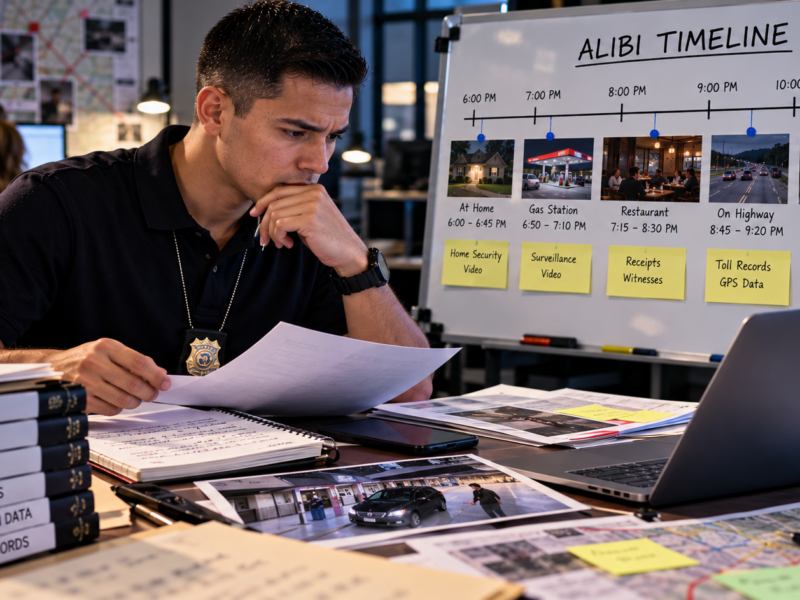
Perhaps one recruit overlooks important facts.
Another communicates poorly under pressure.
And another reaches reasonable decisions but cannot clearly articulate why.
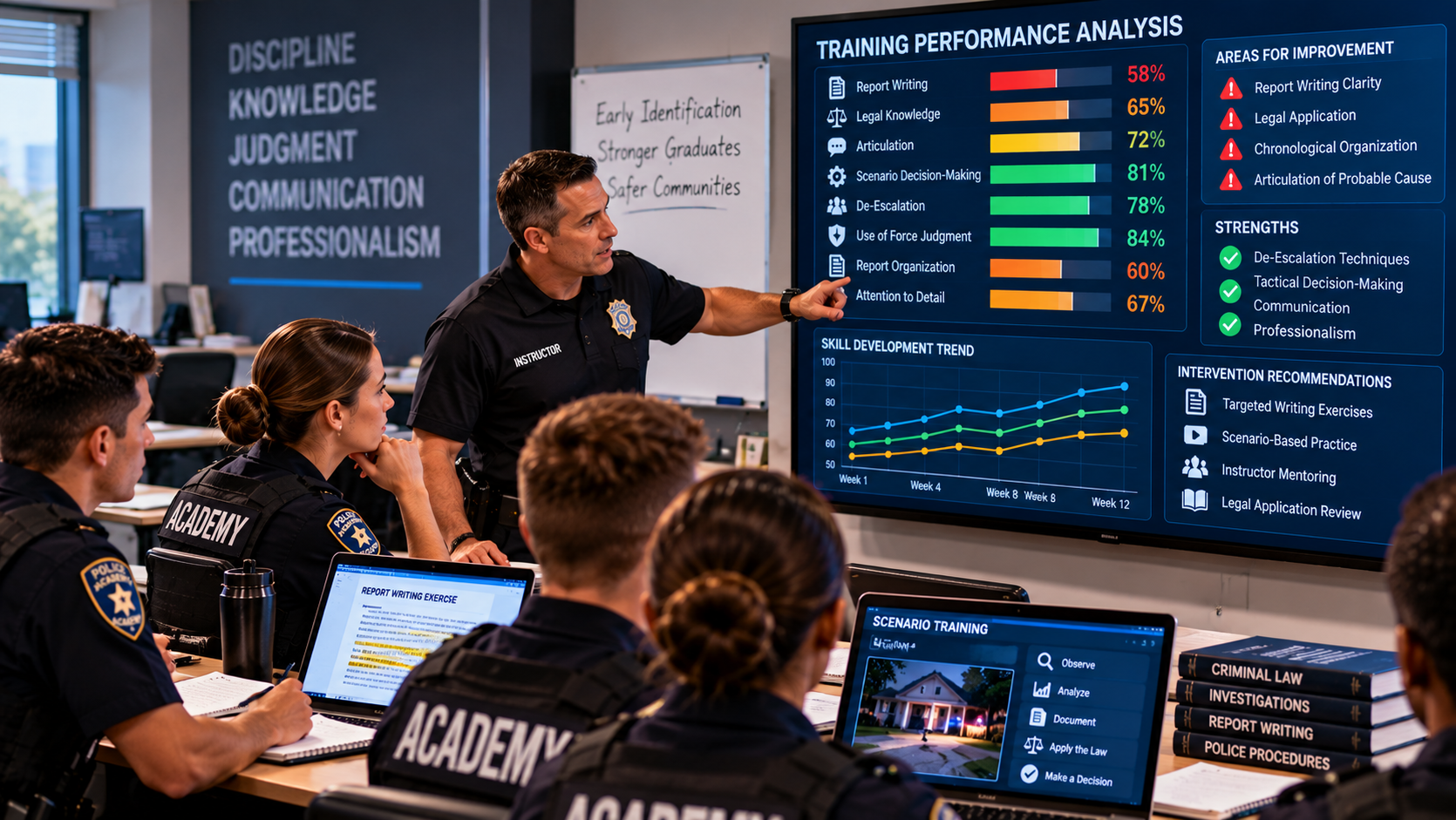
Scenario technology could let instructors spot those patterns before graduation, when correction is still training rather than remediation.
AI should not replace instructors.
Its greater value may be helping instructors see patterns that repeated simulations make measurable.
The future police academy may therefore focus less on proving recruits completed training and more on proving they can apply what they learned before the consequences become real.
–Klyvorek & OpenAI
KLYVOREK helps law enforcement professionals strengthen report-writing and documentation skills through realistic fictional scenarios, self-paced practice, and AI assistance. The officer provides the facts. KLYVOREK builds the draft. The officer reviews, refines, and improves it.
____________________________________
References
Halton Regional Police Service. (2026, October 8). Harnessing AI to enhance public safety: HRPS first in Canada to deploy innovative 911 training and recruitment technology.
Halton Regional Police Service. (2026, October 8). Media opportunity—First police service in Canada to use AI training tool.
Landman, A., Nieuwenhuys, A., & Oudejans, R. R. D. (2025). Decision-making training for frontline police officers: Effects on situational awareness and team behavior. Scandinavian Journal of Psychology.
O’Neill, J., O’Neill, D. A., Weed, K., Hartman, M. E., Spence, W., & Lewinski, W. J. (2019). Police academy training, performance, and learning. Behavior Analysis in Practice, 12(2), 353–372.